Waterfalls

NP 7 tazas – Salto del Laja

We arrived at a very nice campsite just outside the NP “Siete tazas”. The name translates as “seven cups” describing the river as it falls in several spectacular waterfalls into little bowls that the river had carved out of the hard rock here.

We camped and had a nice evening with 2 guys from Israel before we took our bike to the entry of the national park. A little hike brought us to a canyon. A small trail led through a colorful forest and down the canyon, offering fantastic views on the waterfalls.

We continued south and after a stretch on the PanAm we found a nice hotel close to another great waterfall, the “Salto de Laja”. Our hotel happened to be right at the edge of one side of the waterfall and we had a view on it directly from our room.

The next day we wanted to have a better look at it.

It was closed though. As we approached the gates we could see a lot of people with tired and sad expressions. A police officer stood in the entrance of a little path that led to the waterfalls. A rescue vehicle stood aside.

A little girl of 13 years age fell into the water underneath the waterfall and had been pulled into a powerful undertow the day before. She was still trapped there and we could hardly imagine what the poor parents went through, sitting there and waiting for the officials and rescuer to bring them the body of their daughter.

We felt very bad, standing there with our cameras, excited tourists that hoped to see a great natural site… and there the poor family going through the most unimaginable pain.

We turned our bikes around and left.

It was a quite ride and we both wished the best for the poor family.

Big waves and into Santiago

NP Pan de Azucar to Santiago

We left the national park Pan de Azucar and continued along the coast for a few kilometers before we got on the PanAm again and just flew down the 4 lane highway with a short stopover in Vallenar, where we found a really nice hotel.

La Serena is a really nice colonian style town and again we found safe parking and a real nice hotel just around the corner of the central plaza where we stayed for the night.

We continued our long stretch of days on the PanAm. Riding was very relaxed. Not too much traffic, the broad lane of the PanAm, an enjoyable landscape. Nothing to get overly excited about, but after all these eventful days in Bolivia we almost enjoyed not to “have to stop and look at something”. We just rode. You can let your mind fly away, think about the journey, about the country, about friends, family or just keep your mind busy by calculating how much time you would need to the next exit/town/gasstation when riding at different speeds (something I did a lot and I can proudly announce that I became the master of “I-will-be-at-the-next-exit-in-X.XX-minutes-at-the-momentary-average-speed-of-Y-km/h-sort-of-calculation”).

After we had enough of long straight roads, we decided to make a little detour via Monte Patria. It turned out to be a pretty road with some lakes, lots of curves and very little traffic.

We did not want to arrive late in Santiago and so we decided to find a place somewhere at the coast for the night.

And we found a pretty one: Pichidangui turned out to be a little village on a fantastic rocky coast. The deep blue ocean breaks its waves powerful on the black rocks of the coast. The setting sun added some warm color to the scene. And the birds contributed their squawking noises to the thundering sound of the breaking waves. It was a mind-blowing scenery.

On the road the day before we had to stop on a construction site. I chatted with the guy standing in his car behind me and he told me his friend owns a hostel where lots of motorbikers go. He marked the position of the hostel in my navigation (Case Matte 33° 26’22” S ;70° 37’43” W). So we looked for the hostel and drove up and down the road in Santiago until a young guy put his head out of the fence and asked if we where looking for a hostel. It turned out to be Christian, the owner. A motorcyclist himself he decided to start this hostel. For whatever reason it does not have a sign outside, but it is a fantastic place. Safe parking, a kitchen for use, a fantastic roof terrace, fast internet… everything we wanted to have.

He made some phone calls for us so we could get our bikes serviced at BMW.

The next two days we walked around the city, had fantastic meals, even a german Weissbier, had our bikes serviced (it turned out though they did not check the bearings on the steering, so we had to get this done a few days later in Osorno; grrrr).

It was a relaxing time there and a little break from all the riding we did in the past week.

A dusty road and up the mountains

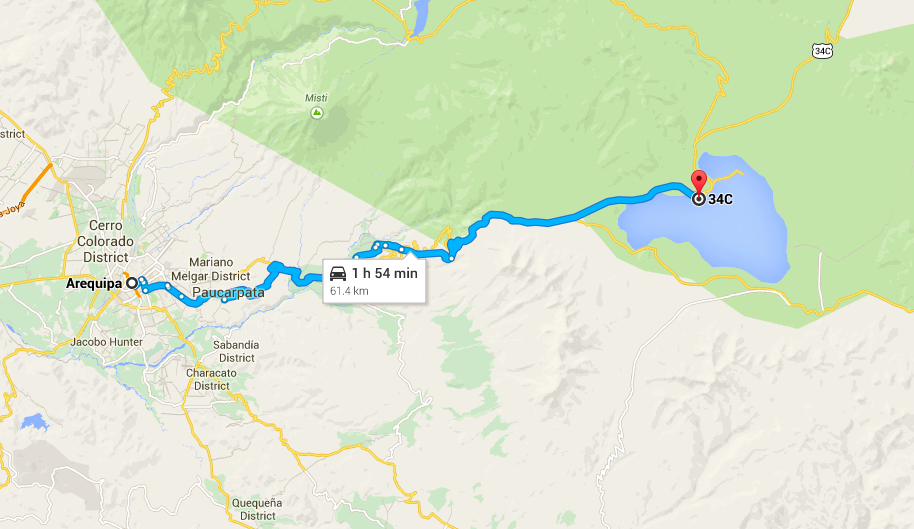
A little road leads all the way from Arequipa through the Salinas national park to Ouno at the Titicaca lake. It would be a pretty long way though and so we thought of instead take a daytrip with no luggage to a laguna in the Salinas NP. It turned out to be a great idea. First because the lake was really nice, and more importantly, we didn’t have any luggage with us: the road was a killer for being on the bikes.

Screen Shot 2014-11-14 at 23.33.47

In endless curves it ran up a mountain. The road was one of the dustiest roads I have ever been on. In the curves the dust was 20cm deep with loose rocks underneath. So if you didn’t have enough speed your front wheel would slide and bounce from one side to the other. The only safe way beside speed was foot peddling through (Christies “powerwalk”).

We were covered in dust. But it was also a road of fantastic views.

Screen Shot 2014-11-14 at 20.58.52

The next day we packed our bikes and took the main road to Puno. It was a great ride: good tarmac, a lot of Vacunas, Lamas and Alpacas, a wonderful landscape.


We enjoyed it a lot. It was very relaxing.


High mountains and deep canyons


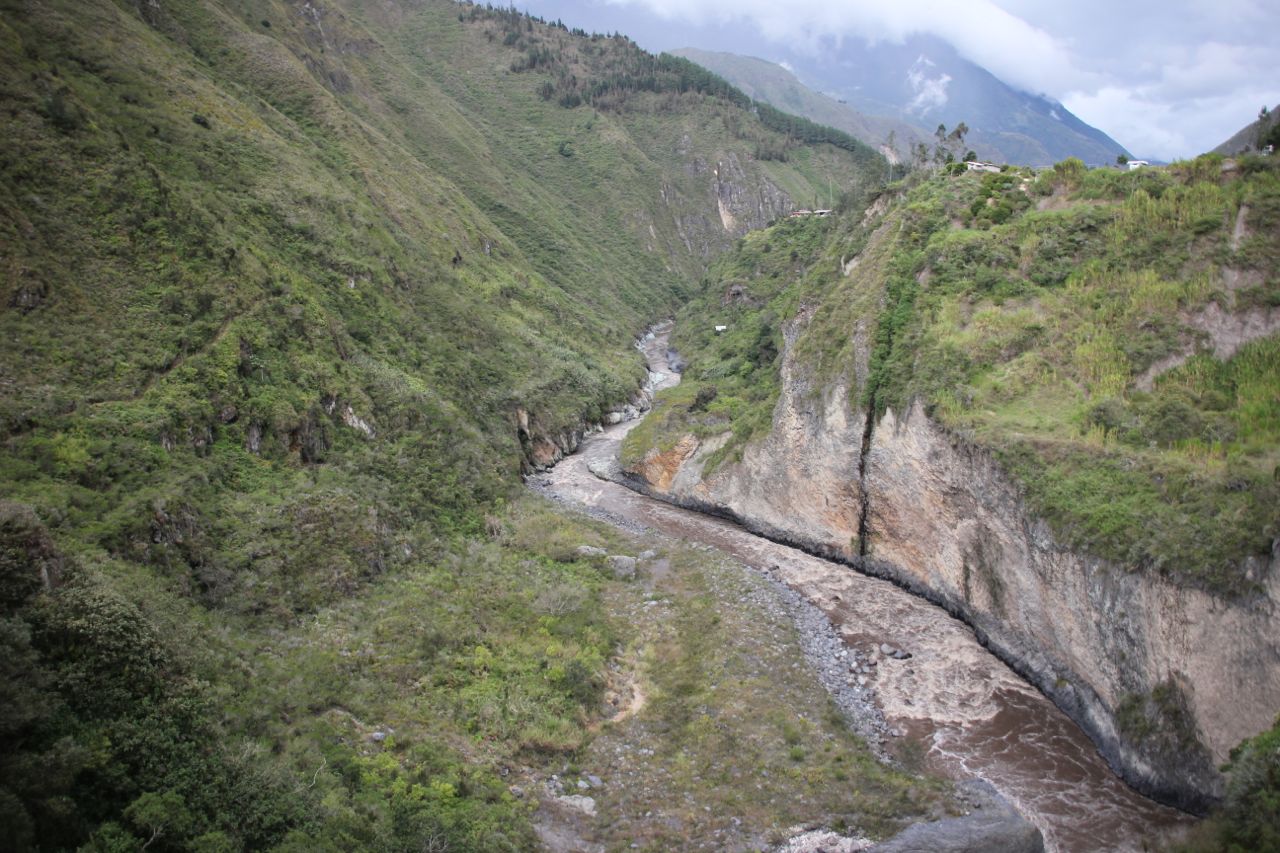
The Canon de Colca is one of Perus natural highlights as they say. It is very often compared to the Grand Canyon. But other than his famous colleague in the US this canyon is not located in a flat area. It is surrounded by the Andean mountains towering with 5200m over it’s river bed. This creates an incredible sight.

The tourists get there by bus from Arequipa as a one or 2-day organized tour.
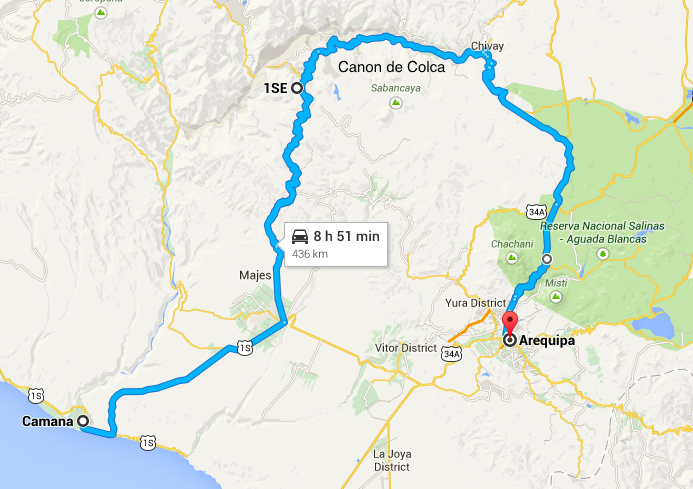
Screen Shot 2014-11-07 at 20.59.55

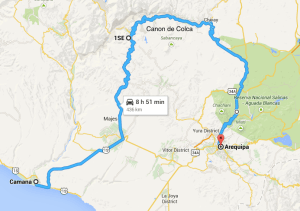
For us on the bikes there are other options of course and so we take a long dirt road via Huambo. We start in Camana driectly on the coast very early in the morning. After 80km on tarmac we turn off to a dusty gravel road. It has quite a lot of corrugations and so our bikes get shaken pretty well.

The road climbs up the mountains and slowly the desert gets a more and more spots of vegetation. Small bundles of grass start to grow and once in a while even a little bush finds enough humidity to live here.

Little flowers contribute yellow spots to the brown of the grass and dust.

After we have about half of the dirt road (80km) the road gets steeper and we start noticing snow covered mountains around us. It turns out to be the surrounding volcanoes, some of them reaching more than 6000m. The landscape is fantastic. A mountain pass at 4200m offers a breathtaking view into a broad valley, which ends in the far distance with a sharp edge, the first sight of the Calco canyon. We make a break, but after being on the coast at sea-level for more than a week, we are pretty out of breath. We continue on the road which is getting more rough but with less corrugations which makes riding actually more enjoyable. There are hardly any cars here. During the 6 hours we spend on the bikes we only saw a handful of cars or trucks.


As we descend from the mountain pass we enter the little village of Huambo. Lots of people in traditional clothing are gathered on the Plaza del Armas, the main plaza. Traditional music is being played from loudspeakers and a lady is commenting the appearance of little dance groups. Trucks and even a bulldozer are setup as floats parading in front of the inhabitants of the village. It is the 124th anniversary of the village and they are celebrating it very nicely. We stand somewhere on the side and get in contact with people immediately. So we stand there, drink some coke and eat some cookies, which we bought from the store next to our bikes and watch the parade going on.

It is really nice and enjoyable.

After a while, just before the parade is finished we jump on our bikes and continue the last 30km to Cabanonde.


The place we stayed is famous for its kitchen (Kuntur Wassi) and so we had a delicious dinner of Alpaca meat. We got up early in the morning to reach a steep cliff. When the early sun hits the canyon condors use the thermal lift to rise up and go hunting. As we approach the Cruz del Condor there are already a couple of tour busses waiting. We jump off the bikes and just make it in time to see some of the huge birds flying-by real close. It is an impressive sight to see this majestic birds sailing in the warm wind.

After 15 minutes the birds are gone. Time to see what else there is to see. The canyon is incredible: deep down you can see the Colca river a 1200m below. Above it the 5200m high Senal Ajiruha mountain towers over the canyon. There are some frozen waterfalls up there. It is almost unreal as the rest of the area is quite dry. We enjoy the view for some more time and keep going following the route of the busses back to Arequipa.

The Canyon gets wider and lots of terraces are build into the walls. It turns very green with all these fields. It is one of the main agricultural areas of Peru. We reach the next town that is at 3600m and fill up our bikes. Then we start the ascent on asphalt now, up to the 4800m mountain pass of Patapamba. The ride is incredible, with great views into the valley of the Colca canyon. The top is quite flat and offers a fantastic sight to the volcanoes surrounding the area.

As we don’t want to take the long main road to Arequipa we decide to take a little short cut. A dirt track leads in between two massive volcanoes (Misti 5800m and Chachani 6000m). The road is pretty good and almost flat so we proceed very well. As we hit the flank of Chachani it gets pretty sandy at some parts though. It is not real sand, it is ashes from the volcanoes and it is very very soft. Christy had some difficulties and I fell twice as well. Since we were at 4000m altitude picking up the bikes was quite a strenuous work.

But most of the time the road was very rocky and so we made it back ok to tarmac and then into the nice city of Arequipa.

We decided to stay a full day there to “recover” from all the incredible sights and rides we have had the last week.

Into the Cordillera Blanca

National park of Huascaran – Laguna Orconcocha – Huaraz

Screen Shot 2014-10-20 at 23.16.48 Screen Shot 2014-10-20 at 23.15.32

Even though the weather was not very stable and clouds covered the mountains most of the time, we wanted to get into the national park of the Cordillera Blanca. A small dirt road brought us the few kilometers from the valley to a deep cut in the mountains. We enter the mountains through these pillars of rocks left and right. It felt like entering a cathedral. The road constantly lead up and finally a crystal blue lake on the right side appeared. The water is intensively colored and looks almost artificial. We stopped and had a look around.

We passed the small lake and continue the valley to a second lagoon. The landscape is unreal. The colorful lakes, steep walls of rock, and above, visible from time to time through the clouds the white glaciers of the high peaks.

At the end of the second lagoon there is an open area, which is marked as campsite. We pitched up our tent and met the only neighbors, a young couple from France who travels for more than one year in their camper with their 2 little children. Since they come from south, we exchanged some information and have a little chatted before the cold forces us to return to the tent.


The next day we made a little hike. We actually wanted to go to Lake 69, a little lagoon which lays in between high mountains. It is a few hour hike, but I didn’t feel very well and so we decided not to finish the way to the lagoon as it is located at 4700m altitudes. It was still really beautiful and we enjoyed every step we took. The hike led through a valley with cows enjoying the warmth of the sun. The flat ground of the valley had rich green gras, a little stream peacefully led through the meadows. As we continued to hike further down the valley, the flat area suddenly ends with steep walls. From all sides long waterfalls feed the little stream that flows in the valley. The highest peak in Peru was just uncovering from the clouds and so we have fantastic views into the high mountains surrounding us.

We left the beautiful valley and headed for Huarez, which we reached just after sunset.

As many cities of Peru Huarez is pretty chaotic when you enter. Traffic and the chaos don’t make it very pleasant to ride through the city.

The city itself doesn’t really have much to offer either. The main topic here is the mountains. On every corner guides offer their trips, rent equipment and advertise adventure tours.

A giant’s burp

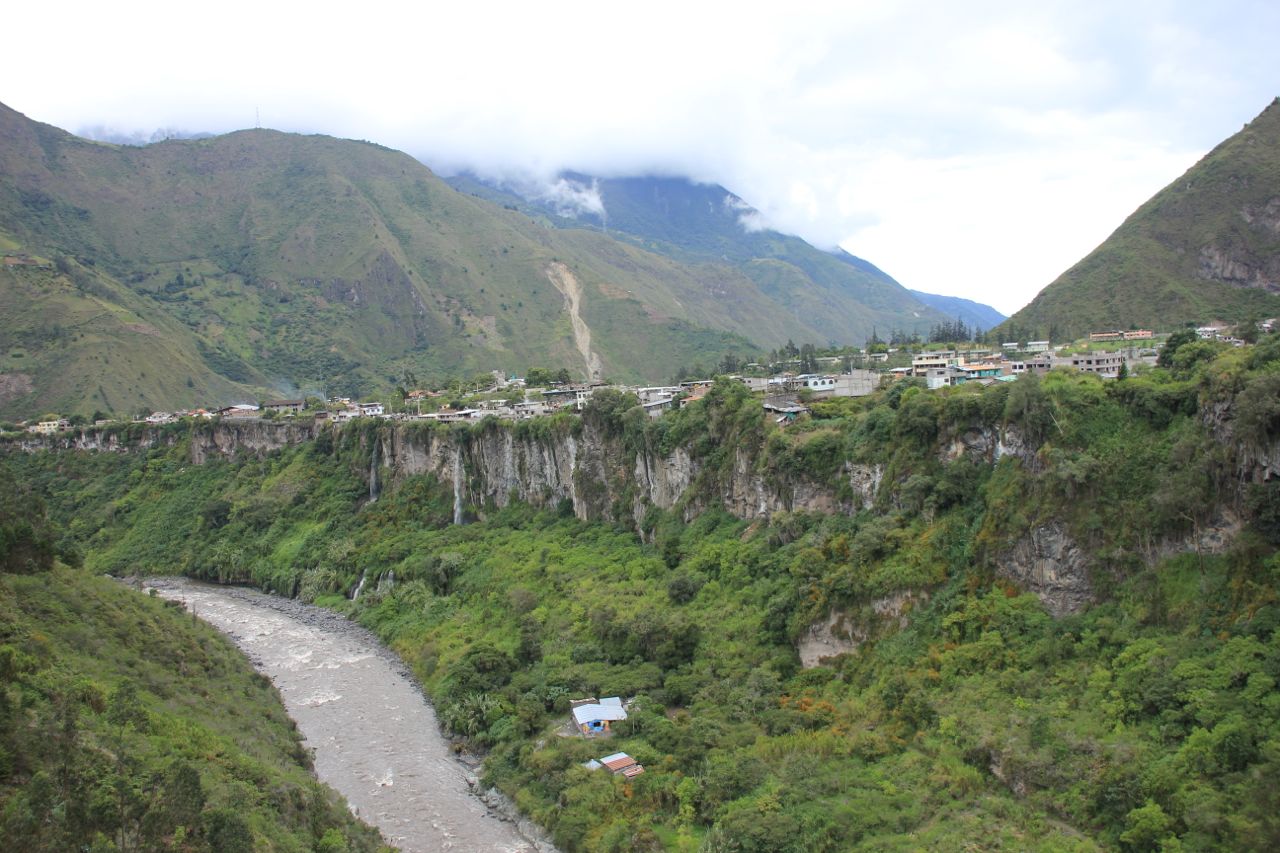
Baños is a very touristy little town with lots of outdoors activities going on. The climate is very nice, around 25 degrees, not humid, just nice and friendly. We had a little break there, taking care of our blog, did some laundry, reading and took half a day of Spanish lessons.

View on Banos

The town is situated directly underneath the Tungurahua volcano, which is not only active, but erupting momentarily. Just a few weeks ago a couple of explosions combined with lava flow and hot ashes floating down to the valley scared the inhabitants of Baños.

The danger is very present. Everywhere within the city there are emergency signs, showing the directions to the evacuation routes. In case of a larger eruption the population is meant to leave the valley on the opposite side of the volcano.

View on Banos

View of Baños

As we were sitting in our room one evening, suddenly a loud noise made us jump to our feed. The whole ground shook. We nervously looked at each other having both the possibility of a large eruption in mind.

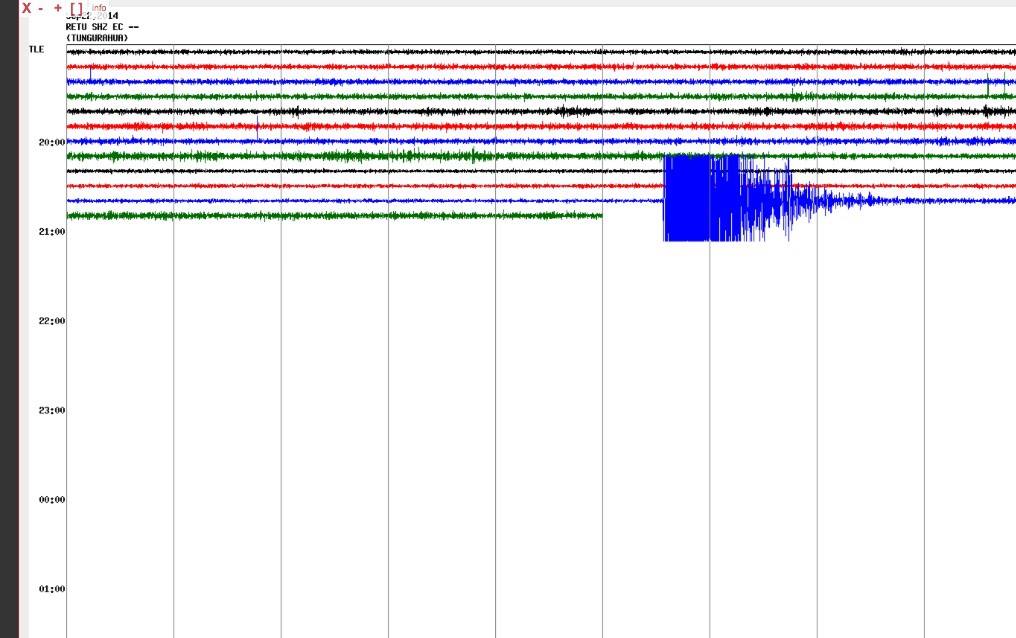
After a few seconds the whole thing was over. We opened the window to hear whether there would be any sirens. We stood there at the window a few minutes, but beside the usual barking of the neighborhood dogs there was nothing to hear. So we decided that this was not that bad after all. We looked up the volcano in Google whether we could see some information, and indeed there was some sort of explosion at the Tungurahua that was shown on some seismographic measurement stations around. But in comparison to what the graph looks like on a “real” eruption it was clear this was only a small burp of this giant.

The little "burp"visible on the live measurement data

The little “burp” visible on the live measurement data

thats how it looks when it you should get ready to run (recorded August this year)

thats how it looks when it you should get ready to run (recorded August this year)

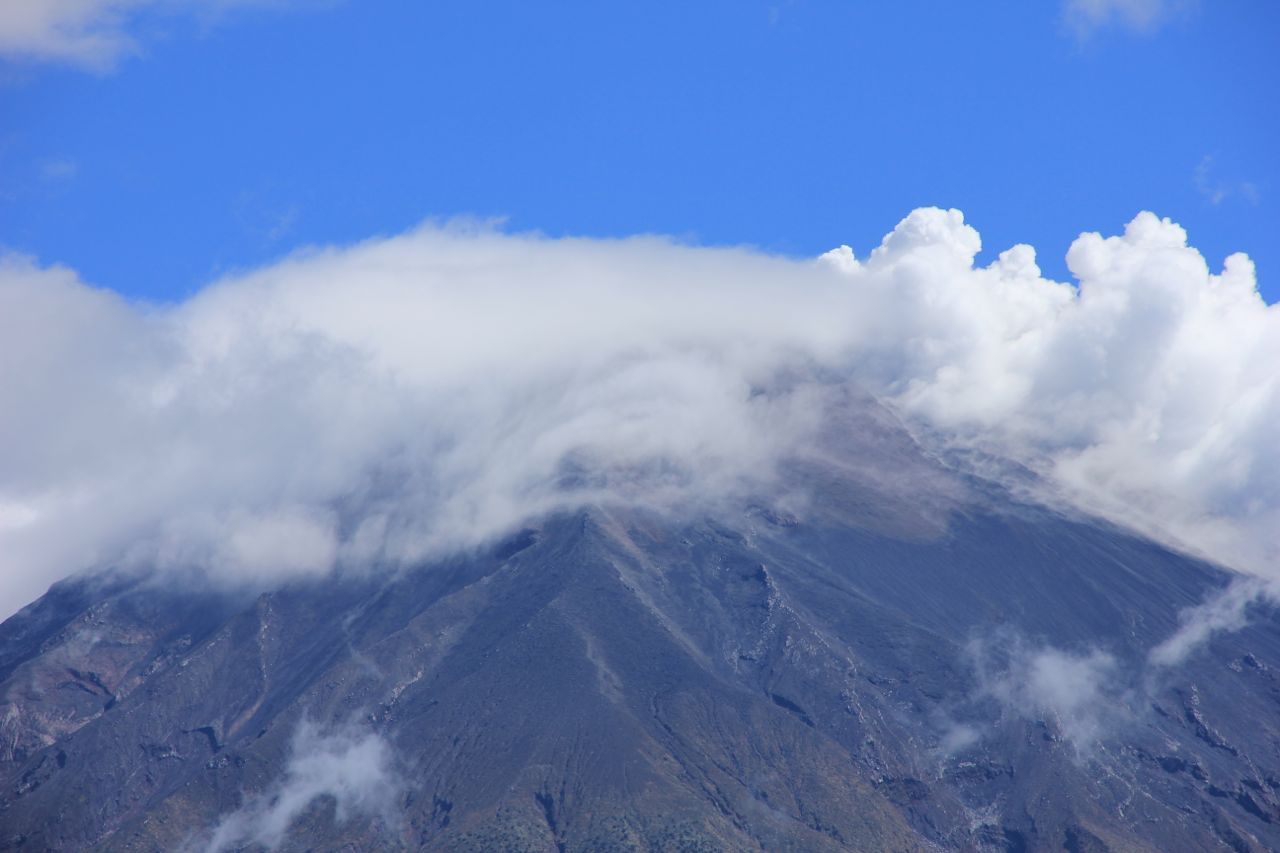
The Tungurahua volcano

The Tungurahua volcano


The volcano is momentarily erupting

The volcano is momentarily erupting

There are several viewpoints on the volcano, but since it was cloudy most of the days we didn’t go there. On the day of our departure from Baños we drove up the mountain opposite of the volcano to have a view. It was still in clouds, but as we were sitting up there the sky cleared up and we had a wonderful view on the Tungurahua.