Big waves and into Santiago

NP Pan de Azucar to Santiago

We left the national park Pan de Azucar and continued along the coast for a few kilometers before we got on the PanAm again and just flew down the 4 lane highway with a short stopover in Vallenar, where we found a really nice hotel.

La Serena is a really nice colonian style town and again we found safe parking and a real nice hotel just around the corner of the central plaza where we stayed for the night.

We continued our long stretch of days on the PanAm. Riding was very relaxed. Not too much traffic, the broad lane of the PanAm, an enjoyable landscape. Nothing to get overly excited about, but after all these eventful days in Bolivia we almost enjoyed not to “have to stop and look at something”. We just rode. You can let your mind fly away, think about the journey, about the country, about friends, family or just keep your mind busy by calculating how much time you would need to the next exit/town/gasstation when riding at different speeds (something I did a lot and I can proudly announce that I became the master of “I-will-be-at-the-next-exit-in-X.XX-minutes-at-the-momentary-average-speed-of-Y-km/h-sort-of-calculation”).

After we had enough of long straight roads, we decided to make a little detour via Monte Patria. It turned out to be a pretty road with some lakes, lots of curves and very little traffic.

We did not want to arrive late in Santiago and so we decided to find a place somewhere at the coast for the night.

And we found a pretty one: Pichidangui turned out to be a little village on a fantastic rocky coast. The deep blue ocean breaks its waves powerful on the black rocks of the coast. The setting sun added some warm color to the scene. And the birds contributed their squawking noises to the thundering sound of the breaking waves. It was a mind-blowing scenery.

On the road the day before we had to stop on a construction site. I chatted with the guy standing in his car behind me and he told me his friend owns a hostel where lots of motorbikers go. He marked the position of the hostel in my navigation (Case Matte 33° 26’22” S ;70° 37’43” W). So we looked for the hostel and drove up and down the road in Santiago until a young guy put his head out of the fence and asked if we where looking for a hostel. It turned out to be Christian, the owner. A motorcyclist himself he decided to start this hostel. For whatever reason it does not have a sign outside, but it is a fantastic place. Safe parking, a kitchen for use, a fantastic roof terrace, fast internet… everything we wanted to have.

He made some phone calls for us so we could get our bikes serviced at BMW.

The next two days we walked around the city, had fantastic meals, even a german Weissbier, had our bikes serviced (it turned out though they did not check the bearings on the steering, so we had to get this done a few days later in Osorno; grrrr).

It was a relaxing time there and a little break from all the riding we did in the past week.

Sand and Sea

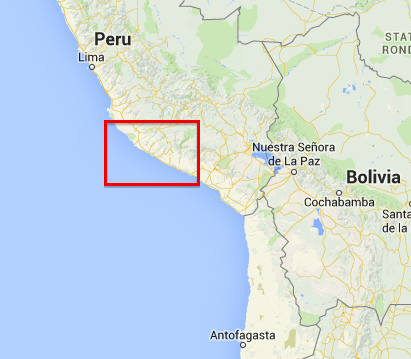
Nazca to Camana

Screen Shot 2014-11-06 at 15.29.55

Screen Shot 2014-11-06 at 15.29.24

We left Nazca to make a little detour to have a nice view on the Cerro Blanco, the highest sand dune in the world. We are not very tempted by superlatives, but this dune is an astonishing 2800m high, just 50km from the sea. We love sand and dunes and so we were very curios to see it.

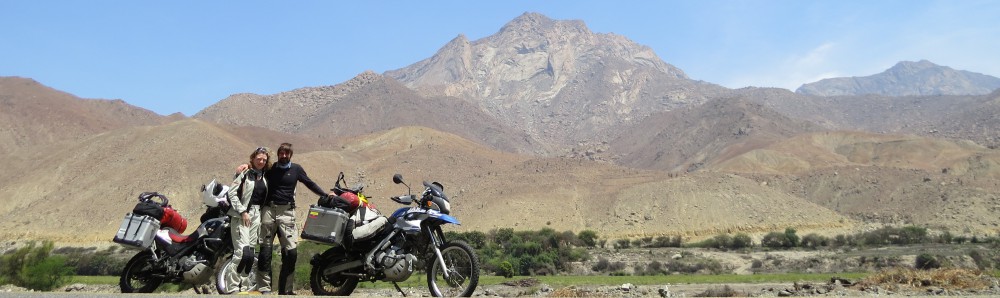
We ride into a dry valley which starts right in Nazca. On both sides mountains with soft shapes accompany the valley. Almost no vegetation is found here; just on the bottom of the valley there must be a little bit of water as some plants create a pattern of green once in a while.

Suddenly the peak of the Cerro Blanco appears over the smaller mountains in the foreground. The name is describing it pretty well. With all the brown mountains surrounding us the bright color of the Cerro Blanco sticks out and appears almost white. We find an opening in the mountains and turn off the paved road to get a closer look. Soft sand makes riding a lot of fun and as we approach we finally see the full flank of the mountain. A wall of more than 2300m of sand is piling up in front of us. It is an incredible sight.

We ride further down the bumpy track until it gets too difficult for Christy on her heavy bike.

We go back to the main road and continue until we reach a mountain pass. From here you can approach the summit of the Cerro Blanco. We stop, enjoy the view and play a little bit in the soft sand, but there is no point on continuing uphill with the loaded bikes.

So we turn around to Nazca and keep going south the PanAm.

After a few kilometers we get off it again to follow a sandy dirt road to a cemetery from pre-inca times: Chauchilla. Tomb raiders have dug the ground to find treasures and so the dead had been laying there in the open field for centuries. A few years ago officials have restored some of the graves and put the bodys into their original graves.

Since in the past years people have wandered around the dead and sometimes even posing with them for photos I think restoring the graves has been a great thing to do. It gives some dignity back to this place.

The whole place still is covered in bones, hair, clothing, clay fragments and other parts of the graves. All over are little dips, indicating other graves that have been opened.

We are the only visitors. It is boiling hot in the sun. The place is surrounded by hills in different colors. The place offers a strange morbid beauty and peace.

The deads have been dried in their graves to mummies. The many years in the sun have whitened their bones. So here they sit in their new graves with some rests of their belongings. It is really macabre and strange. But also beautiful and peaceful.

We hit the PanAm at around 1 and we have decided to go till the town of Chala. We expected the road to be sort of boring and to be one of the parts where we would just cover distance.

But we were wrong! It was a fantastic ride with lots of stops to enjoy the constantly changing scenery.

The landscape can be described in one sentence: Desert to the left, black strip of PanAm in the middle, blue sea to the right.

But the diversity was mind-blowing: we passed sections with complete flatness, areas with beautifully shaped rocks, colors of red, green and yellow. At one point the dunes towered a few hundred meters and rose directly from the sea. About have way up the PanAm crosses the dunes flank. We passed deserted sand beaches for kilometers. Sometimes the coast was rocky with the waves wildly shattering on the cliffs. Sometimes the sea was rolling in long surfers paradise waves upon shallow beaches.

The sea was deep blue, forming a perfect contrast with its freshness and vivid nature in comparison to the complete lack of water and lifeless desert on our left.

It was 400km of pure pleasures. From Nazca to Camana with an overnight stop in Chalca.


Cattle and penguins

After we stayed in Lima for another day to fully recover from my illness we started on our way south. Parracas is a small town 200km south of Lima that lives from the tourism. The reason for tourists to come to this little place is a couple of islands close to the cost. A huge number of different birds live on these little islands together with a small penguins and sea lions.

After a noisy night (it has been Halloween night with a lots of drinking and singing going on in town) we got up to line up with these hundreds of tourists. Large groups of tourists were coordinated by the trip organizers. I felt a little bit like being in a herd of cattle, not exactly knowing what was going on around me. The tour guide that picked us up from the hotel has disappeared and so we end up in a different group of people. And like one of the herd I just thought we best go with the masses and finally just ended up in one of the boats somehow.

Once we left the harbor the many boats spread so that you could hardly see any other boats. We past a large sign that was carved into the shore, a few hundret meters long. As the geoglyphes at Nazca they meaning is unknown but quite impressive. And even though this carving has been directly at the sea, influenced by the strong winds here, it lasted for so long.

We leave the coast and the boat takes course to the islands. The islands are a sight for itself: a couple of rocks laying there in the sea with steep cliffs and a lot of caves and bridges. It looks like the phantasy island of a pirate movie and I wouldn’t have been surprised a lot if the Black Pearl appeared suddenly.

There are birds everywhere: small black ones, large pelicans, white middle sized… in fact birds of all colors and sizes. And they are all in large numbers. A constant cawing of thousands of birds mix with the splashing sound of the waves crashing on the rocky shores of the islands.

The smell is an interesting mixture of the salty sea and the bird’s dung in which the rocks are covered. In fact this dung used to be one of the main export goods of Peru as it is known as one of the best fertilizer.

The captain of our small boat maneuvers the vessel very close to the shore, so we got a perfect view on all these different animals. And there is more than just birds: sea stars, crabs, shells of all different kind appear. And finally some birds I wouldn’t have expected here: penguins. These little cute things are staying here on this island. It is a very small type: Humboldt Penguins. They are really fantastic with their clumsy way they move around solid ground. And it is tricky terrain for them with all the steep rocks and the high steps they have to take. Just watching one of them helplessly trying to get up on a rock made my day. He fell over on his belly again and again, but eventually he made it. Persistent little guy!

Going around another corner of the islands finally sea lions hang around on little mini islands. The males posing and showing off, some getting into a real fights and others (most of them) just hanging around lazy on the rocks. The way they lay there make the rocks look like a real cozy place even though some of them lay there in a real uncomfortable situated places.

It was fantastic to see these animals so close in their natural sorroundings. They seem to be totally fine with the situation and just look at you in a mixture of boredom and curiosity.

The whole boat trip took two hours of which one hour we spend with the animals on the island. It was a fantastic tour and made me even forgot the terrible herding experience from the morning.

We happily returned to the hostel and packed our bike to make it to Nazca the same day.