Big fat cows on green meadows

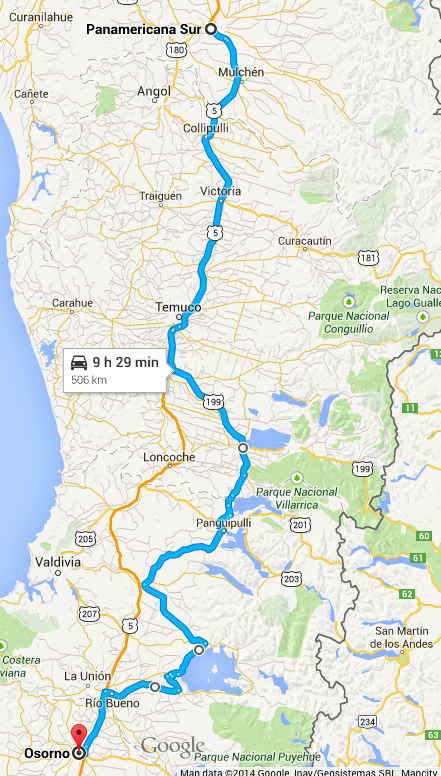
Salto de Laja – Villarica-Osorno

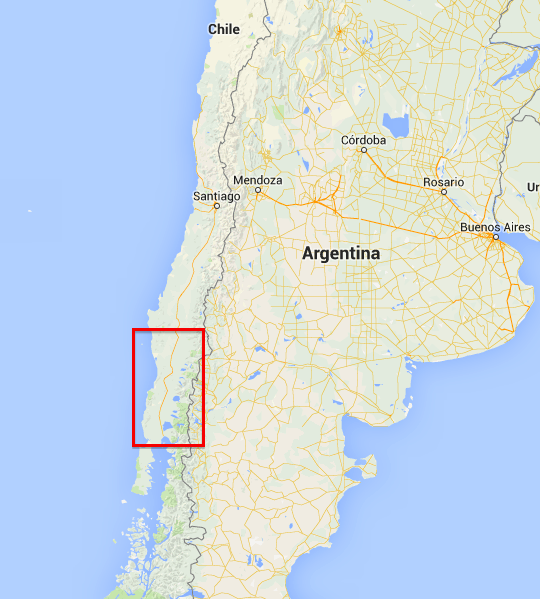
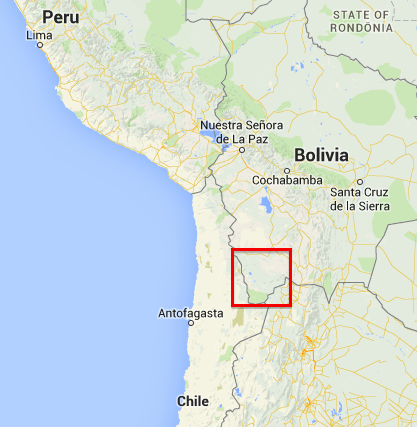
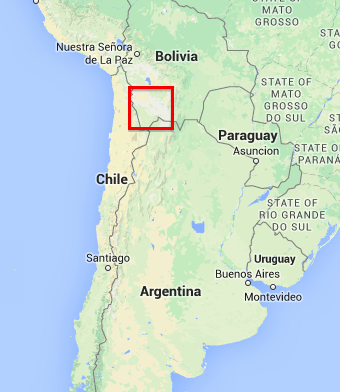
Screen Shot 2014-12-21 at 22.36.37 Screen Shot 2014-12-21 at 22.45.53

Just a week ago we had passed the Atacama desert, on of the driest areas on this planet. And now this: all shades of green. Big trees, high grass, thick bushes.

And all among it: cows. Lots of them. Big fat cows. And sheep.

This is cow paradise. We drove along a nice road, the sun was shining, it was warm, almost hot.

The road passes fantastic lakes with high snow covered mountains sorrounding it. This looks like picture book Switzerland except you won’t find a perferctly shaped volcano there.

We rode the bikes along the shores of Lago Villarica and Lago Ronco. The lake district of Chile is a fantastic area. And after all the desert that we have seen on our trip this is exactly what we our souls were thirsting for: lots of green and lots of water. We had sunshine all these days as well and the roads were in perfect condition. And so Christy came to the conclusion that if you could ride a bike in heaven, it would be just like here.

Waterfalls

NP 7 tazas – Salto del Laja

We arrived at a very nice campsite just outside the NP “Siete tazas”. The name translates as “seven cups” describing the river as it falls in several spectacular waterfalls into little bowls that the river had carved out of the hard rock here.

We camped and had a nice evening with 2 guys from Israel before we took our bike to the entry of the national park. A little hike brought us to a canyon. A small trail led through a colorful forest and down the canyon, offering fantastic views on the waterfalls.

We continued south and after a stretch on the PanAm we found a nice hotel close to another great waterfall, the “Salto de Laja”. Our hotel happened to be right at the edge of one side of the waterfall and we had a view on it directly from our room.

The next day we wanted to have a better look at it.

It was closed though. As we approached the gates we could see a lot of people with tired and sad expressions. A police officer stood in the entrance of a little path that led to the waterfalls. A rescue vehicle stood aside.

A little girl of 13 years age fell into the water underneath the waterfall and had been pulled into a powerful undertow the day before. She was still trapped there and we could hardly imagine what the poor parents went through, sitting there and waiting for the officials and rescuer to bring them the body of their daughter.

We felt very bad, standing there with our cameras, excited tourists that hoped to see a great natural site… and there the poor family going through the most unimaginable pain.

We turned our bikes around and left.

It was a quite ride and we both wished the best for the poor family.

Fruits, vineyards and a nail

Valparaiso to Santa Cruz

We left Valparaiso and followed the route “Ruta fruta”, as they call it since all kind of fruits are grown here. Momentarily there is strawberry time. And everywhere they offered big baskets of these bright red fruits. We did not buy any though (I guess we thought we would buy them later till we finally had left the area… a mistake I keep doing repeatedly on my travels).

Instead we got into an area, which was full of vineyards. Grape vines everywhere. It was steaming hot, even though we had been freezing just a few hours before on the coast where the wind blows from the icy cold pacific.

But inland the Heat.Was.On.

It was not far to our destination when we passed this fantastic house in the middle of the vineyards. We stopped and quickly decided to stay here for the night.

The owners grow and sell grapes to the surrounding vineries. We had a fantastic view on the fields. A short swim in the nice little pool cooled us down.

After my swim I realized I had a flat tire. I located a 3cm nail sticking out of my rear tire. I decided that this would be a quick fix and disassembled the rear wheel. But when it came to take the tire off the rim it just wouldn’t work how I expected.

I used all the tricks I knew and had heard of. But it was too tight. Even with the help off the receptionist, a massive 1,5m crow-bar, mother gravity and his weight of approximately-pretty-much we didn’t get the tire off the rim. The whole action was accompanied by a wide variety of German and dialect curses (such as “godverdamminomool”), intranslatable …). But then I was told there is a vulcanizador just around the corner and so I brought the wheel there the next morning and with the right machines it was off in not time. In South America a lot of tires get repaired, other than in Germany. The profession is called vulcanizador, so this was the right guy to go to. He got everything fixed within a few minutes and we were off the road again.

Big waves and into Santiago

NP Pan de Azucar to Santiago

We left the national park Pan de Azucar and continued along the coast for a few kilometers before we got on the PanAm again and just flew down the 4 lane highway with a short stopover in Vallenar, where we found a really nice hotel.

La Serena is a really nice colonian style town and again we found safe parking and a real nice hotel just around the corner of the central plaza where we stayed for the night.

We continued our long stretch of days on the PanAm. Riding was very relaxed. Not too much traffic, the broad lane of the PanAm, an enjoyable landscape. Nothing to get overly excited about, but after all these eventful days in Bolivia we almost enjoyed not to “have to stop and look at something”. We just rode. You can let your mind fly away, think about the journey, about the country, about friends, family or just keep your mind busy by calculating how much time you would need to the next exit/town/gasstation when riding at different speeds (something I did a lot and I can proudly announce that I became the master of “I-will-be-at-the-next-exit-in-X.XX-minutes-at-the-momentary-average-speed-of-Y-km/h-sort-of-calculation”).

After we had enough of long straight roads, we decided to make a little detour via Monte Patria. It turned out to be a pretty road with some lakes, lots of curves and very little traffic.

We did not want to arrive late in Santiago and so we decided to find a place somewhere at the coast for the night.

And we found a pretty one: Pichidangui turned out to be a little village on a fantastic rocky coast. The deep blue ocean breaks its waves powerful on the black rocks of the coast. The setting sun added some warm color to the scene. And the birds contributed their squawking noises to the thundering sound of the breaking waves. It was a mind-blowing scenery.

On the road the day before we had to stop on a construction site. I chatted with the guy standing in his car behind me and he told me his friend owns a hostel where lots of motorbikers go. He marked the position of the hostel in my navigation (Case Matte 33° 26’22” S ;70° 37’43” W). So we looked for the hostel and drove up and down the road in Santiago until a young guy put his head out of the fence and asked if we where looking for a hostel. It turned out to be Christian, the owner. A motorcyclist himself he decided to start this hostel. For whatever reason it does not have a sign outside, but it is a fantastic place. Safe parking, a kitchen for use, a fantastic roof terrace, fast internet… everything we wanted to have.

He made some phone calls for us so we could get our bikes serviced at BMW.

The next two days we walked around the city, had fantastic meals, even a german Weissbier, had our bikes serviced (it turned out though they did not check the bearings on the steering, so we had to get this done a few days later in Osorno; grrrr).

It was a relaxing time there and a little break from all the riding we did in the past week.

3P-Info Part: Salar de Uyuni

The Salar de Uyuni is one of the most amazing places I have ever visited.

Crossing it on a motorbike is priceless. Don’t miss it.

Get there:

To get to Uyuni from LaPaz there are basically two options:

1. direct road from Challapata to Uyuni

2. continue in Challapata on the Ruta 1 to Potosi and then go west to Uyuni.

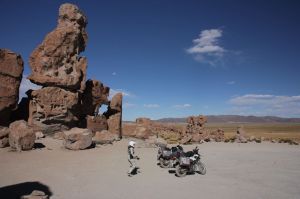
The first option is a really bad road. Lots of cur rogations, sandy parts, lots of construction. They are building a new road, so in a few months this might be a good option. But certainly till middle of 2015 this is a very bad road for 160km. But it is very beautiful and there a nice spots to pitch your tent on the way (eg. rock formations few km before Rio Mulatos).

The second option is all paved and in good conditions. Potosi seems to be a nice city with a silver mine. So this is by far the easier route.

It case in rains:

In case it had rained, it is strongly recommended (by a lot of people, including local guides and international motorbike guides) to not enter on your own motorbike. That is especially the case for modern motorbikes with a lot of electronic equipment. The water splashes everywhere and may cause serious problems. After a day, or a week or a month…

When the lake is whet (in ourcaseonly the first few hundret meters) the salt really gets everywhere.

Some people had to leave their motorbike there as the electrics got so badly torn up, that it was not repairable. Of course you can also go with your own bike if it is wet, if you are lucky you won’t have any problems.

You can rent motorbikes though (small Honda 400ccm which are big fun or more powerful DR650).

You can rent them at MTB: http://www.motorcycletoursuyuni.com

They only rent including guide at 200$ per day. Thats quite pricy, but totally worth it. The alternative would be to take one of the many 4×4 organised tours. That is a lot cheaper, but you miss the feeling of riding a motorbike on the salar, which is fantastic.

If the Salar is dry it is safe to go on your own bike

Ride into the void:

There are only few places where you can enter the Salar.

Don’t enter anywhere else and only use the tracks from the 4×4. Off the tracks the surface can be very soft so that you may sink your bike and need a 4×4 to pull it out.

The eastern entrance is in Colchani at the road from Chalapata to Uyuni at approx. 20km north of Uyuni (S20° 17.876′ W66° 56.130′). You can’t miss it. There are 2 salt hotels at the entrance. We haven’t stayed there, but people we met said it was interesting (plus you can see the sunset over the salar there).

Once you are on the Salar you can go wherever you want.

Once in the while little holes (up to 50cm diameter) offer a view into the world of salt crystals underneath (the locals call them “Ojos”). They are no danger and you can go and have a look.

There is an island where all the 4×4 organized tours go to (S20° 14.498′ W67° 37.671′): Isla Incahuasi (formerly Isla Pescado). It has a little hill and offers a fantastic view. Only enter the island from the northeastern end (where you will see some huts and during the day dozens of 4×4, as the rest of the surroundings of the islands may have a thin salt crust).

It is great fun to ride the bike on the Salar. It is not slippery at all.

After the visit make sure to clean your bike at one of the many washing places in town.

Campsite at the beach

San Pedro to NP Pan de Azucar

The copper mine made a great impression on us and so we continued the road to Antofagasta. We crossed the Atacama desert, one of the driest deserts on earth. It wasn’t a very pleasant ride. The landscape became less attractive and everywhere there were little mining cabins and trucks.

Every second car was a red pick-up truck from the national mining company Codelco. A lot of watertrucks passed us on their way to the big mining sites near Calama.

We stayed in a good hotel in Antofagasta and even the car-park there told you that all there is going on in this region is about mining. Beside our motorbikes there were only pick-ups from mining companies.

We continued our way south and the PanAm gets really boring as it gets more inland. Not that the landscape is ugly, but it gets quite repetitive. The only interruption was a sculpture that an artist put up in the desert. The hand of the desert is right next to the PanAm and so we took a short break there in the shadowless boiling heat of the desert.

After 300km of heat and desert the landscape becomes more hilly and nicer. We finally turned off the PanAm to get to the coast to a nice little national park. The NP Pan de Azucar offers a lot of plants (mainly little cactus) that only life in this little area. It is a wonderful landscape as well. The area doesnt get any rain at all. But it gets humid with clouds and fog that rolls in from the coast. We had blue sky and sun all day long, but as we approach the national park the sky gets cloudy. We arrived at the coast on a campsite.

It is a quite little bay with a perfect sand beach, rocks on both ends of the 1km beach.

There are little shelters for cooking set up. All very nicely. We are the only guests. The owners live in a couple of little huts where fishermen have their boats. So we make our dinner and enjoying the beach and the stars all by ourselves. It is beautiful.


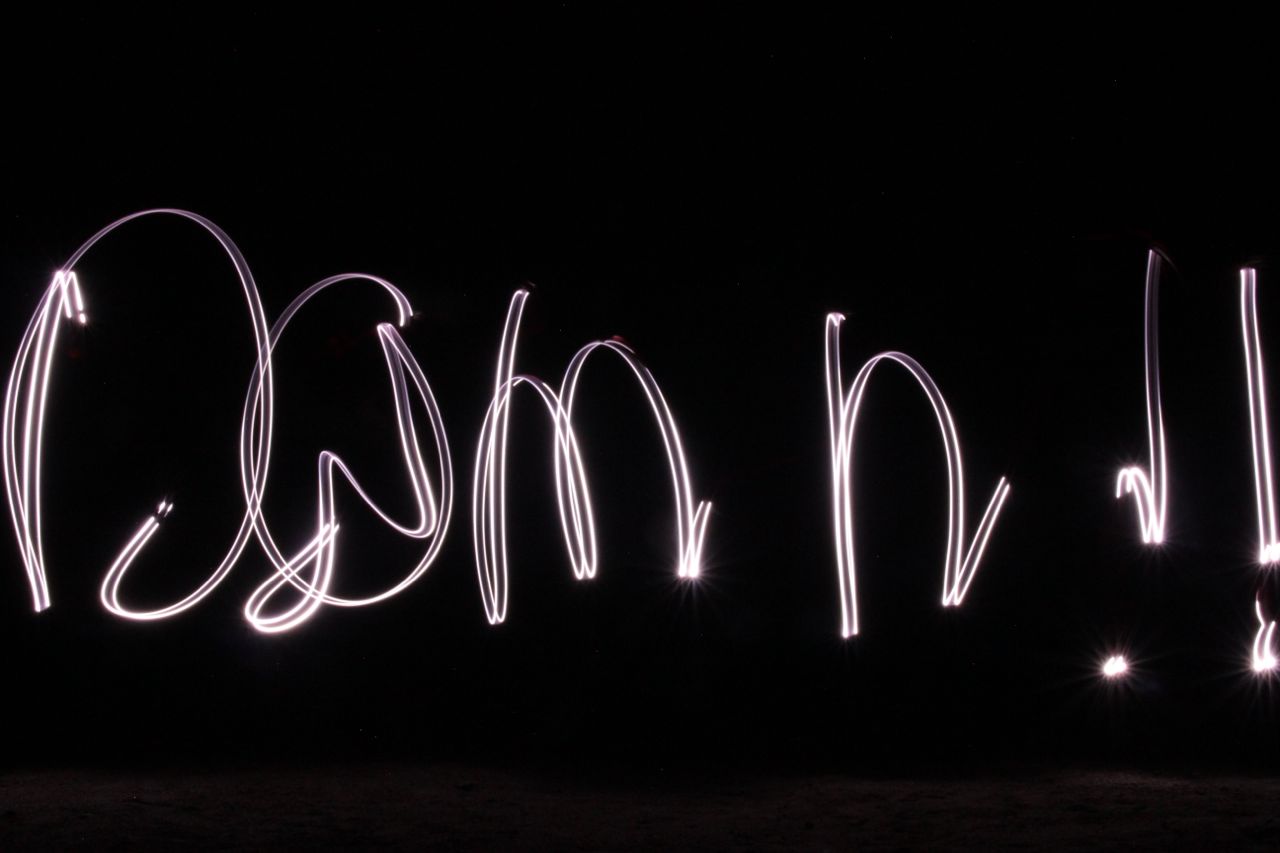
After dark we played around with the camera and Christy wrote my name with her flashlight really nicely. She had to write in reverse and it turned out she is a natural talent to as it is not as easy.

Chisties first attempt. Pretty neat.

Chisties first attempt. Pretty neat.

My attempts were less flattering. These are my best tries (out of many, many, many).

That went well... oh there is a letter missing...

That went well… oh there is a letter missing…

.... and another one missing

…. and another one missing, and why can’t I get the Y right?

....almost...

….almost…

After many other triesI finally gave up and just gave her a kiss instead.

"Damn" I gave up

“Damn” I gave up

3P – Info Part: Southwest Bolivia – Laguna Colorada

Uyuni to San Pedro de Atacama

Riding north to south it seems a logical route to go from Uyuni to San Pedro de Atacama in Chile. It is fantastic ride, don’t miss it.

Here are some pictures from our trip.

Below there is some information about the ride. But first let me give you some general information:

The internet is full of reports about this area. A lot of people who did the ride had a hard time and that’s what they write. Don’t hesitate of doing it though.

With the right preparation everybody can do it on every bike (maybe not a Goldwing or a racebike).

Update: after I got an email of Bob, a great fellow, aged 74, who asked me about some details I would like to add one more sentence here: if you are not an experienced off roader, you have to be prepared to pick up your bike a few times. Little falls just may happen. At altitude of constantly over 4000m (13000ft) and at times over 5000m (16000ft) that might be strenuous. Take your time, take it easy and you are fine though.

We did it on a F650GS Dakar and a G650GS. We had Heidenau tyres which were quite low on profile.

My girlfriend made her license not a year before the trip. She had little experience before the trip and one long weekend offroading with a little Beta200. So you don’t need to be an expert at all. Just prepare and take it easy.

What you need is:

  • Fuel for 500km (we simply bought two 5L fuel cans that we strapped on the bike)
  • Enough water (we had 4L each)
  • Some money for the overnight stays (be reminded that you enter a national park where you have to pay 150Bs entrance).
  • Some snacks to keep you going during the day
  • GPS maps of the area (OSM has a good map which turned out to be very precise in this area). (The paper maps from Reise-Know-How are crap for this part of the journey).

Take your time. We made it in 3 days, which was quite relaxing.

Don’t be worried if something happens: There are many 4×4 running these roads as this is a very common touristic thing to do in organized tours (see below), so there is always help if needed. People will stop when you give them a sign. You can also ask them if you are unsure about directions. Just stop an wait a little bit. There will be someone coming.

The most4x4 tours make the loop: Uyuni-Salar-San Juan-Laguna Colorada- Laguna Verde- Villa Mar-San Cristobal-uyuni(3 days).

The 3 options:

There are basically 3 ways from Uyuni to San Pedro de Atacama.

  1. The Lagoon route via San Juan
  2. The route via San Cristobal
  3. The route via Tupiza
  1. The lagoon route is the by far most sandy one. It has a stretch of more than 60km (depending on the conditions up to 90km) sand. You pass a lot of lagoons and this is the route the 4×4 take from Uyuni via San Juan to the Laguna colorado all along the Chile-Bolivia border. You also pass the famous Arbol de Piedra, a rock formation that looks like a tree. For motorbikers this is the most strengous version.
  1. San cristobal route: This route is the one we took. It seems to be the easiest one. The first bit is in very good condition (almost like a paved road) and there are only short sandy bits of road (max. 1km). Most parts of the road are rocky and easy to ride. You pass a nice lagoon and some incredible rock formations that are certainly as spectacular as the Arbol de piedra. You can devide the road in 3 days or do it in 2 days (but that would be pretty hard or you are experianced off roader).
  1. The route via Tupiza is also pretty sandy, not as much as the Lagoon route (I was told by a 4×4 tourguide). It brings you to places where Butch Cassidy and Sundance Kid lived and died. This route I have the least information on, but for people who are experianced offroaders and who want to spend some more remote time this would be the route. There are not as many 4×4 tours on this road.

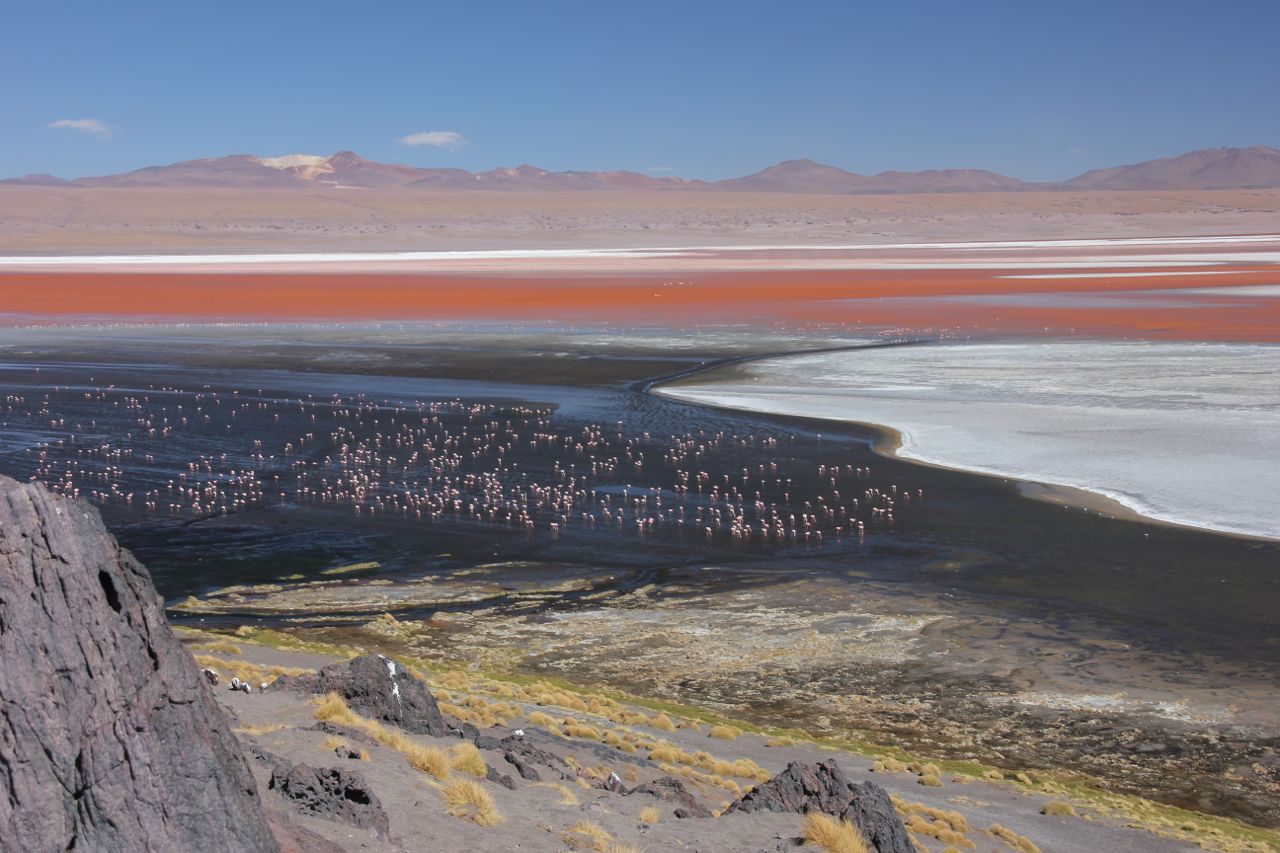
Info Laguna Colorada

Flamingos, thousands.

Flamingos, thousands.

Route 1 and 2 are meeting at the Laguna Colarada.

There is a camp there (S22° 10.260′ W67° 49.049′) where all the 4×4 groups stay. Simple rooms usually as dorms, but you can also rent a complete dorm for yourself if you want to have some privacy.

There is another one (calls himself a hotel, but is not better than the camp(Info from a 4×4 tour guide) south of the Laguna Colorada (S22° 15.802′ W67° 48.961′). Here you can also buy water and snacks.

Close to the camp there is a lookout (S22° 10.222′ W67° 48.279′).

DO NOT MISS THAT. If you are doing route 2 go around the laguna (or take a short cut on the north side of the laguna) and go there. All the tourists go there so the place gets crowdie at times, but this place is incredible. The colors of the lagunas are in general better in the afternoon, as the strong afternoon winds stir up the water and the bacteria in it which create the great color

 Detailed describtion of Route 2:

Uyuni – San Cristobal – Villa Mar – Laguna Colorada – Camp Laguna Colorada – Geysers – Laguna Verde

The road leaves Uyuni south west direction. You pass a gas station (S20° 28.174′ W66° 49.200′) and leaving the town. The road is in very good condition. You can easily go 80km/h. In San Cristobal there is a gas station, but it does not always have fuel. So don’t count on it. But if you have very little reserve, you can try to get some fuel here.

There are also some shops where you can get water.

Shortly after the town of Villa Alota take a left (at S21° 23.974′ W67° 36.893′).

The road gets rougher now. A little bit of dust and sand is on the rocky road, so take it easy. Shortly after the turn off there is a water crossing. It is approximately 40cm deep and rocky. So you may get your feet wet. They are building a bridge there, so end of 2014 you may have a less adventurous crossing there.

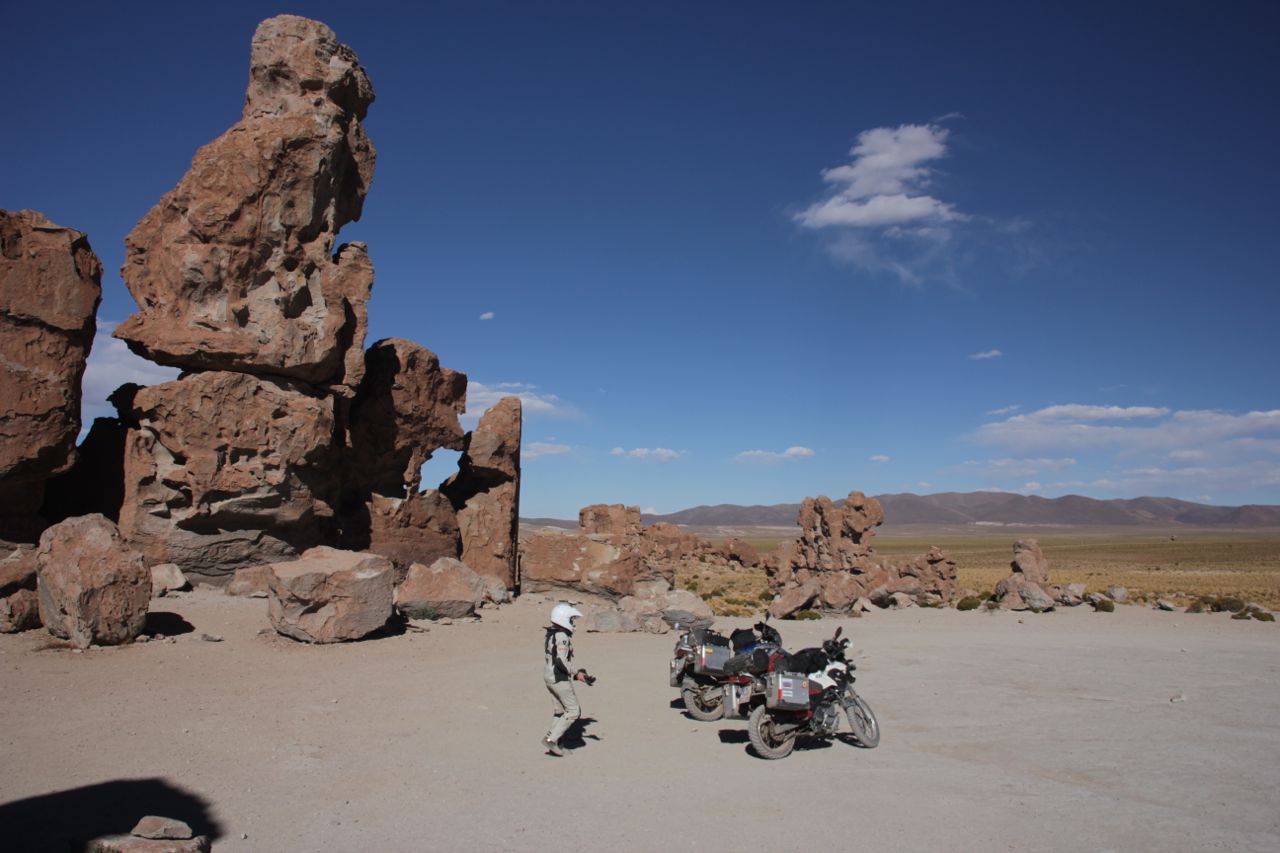
The road gets up the mountain and soon you will see amazing rock formation right next to the road on your right hand side (S21° 32.155′ W67° 34.742′). If you plan to camp, this is an excellent place.
IMG_4103 copy

The following part of the road is a bit sandy at parts, but never long stretches. And the sand is never really deep. So you can “powerwalk” through the sandy parts.

In Villa Mar there are a couple of simple B&B. The tours stop here on the way home from the Laguna Verde. We stayed here in a simple B&B at the end of the town and had a great meal in the evening and a good (simple) breakfast. You can also buy water here.

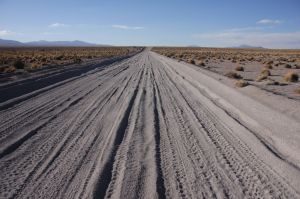
Shortly after Villa Mar you have to turn off the main road. The turn off is here (S21° 46.208′ W67° 27.818′).
IMG_4147 copy

Turn to the right and follow up the hills into a beautiful little valley which I like to call “Lama paradise”. If you get there, you know why. The road gets pretty rocky here.

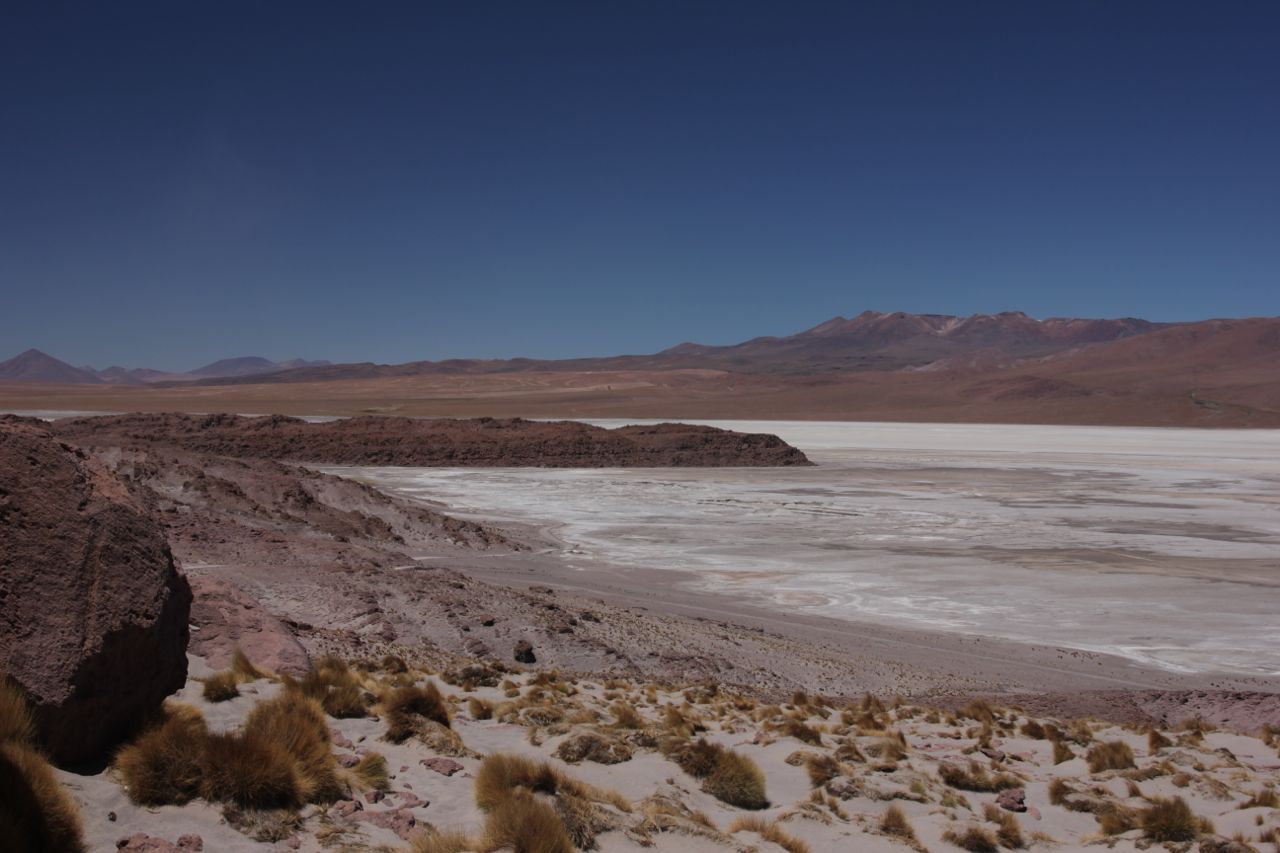
After a few kilometers you arrive at the first lagoon (Laguna Capina). You have a nice view on it. So make a break and enjoy the view.
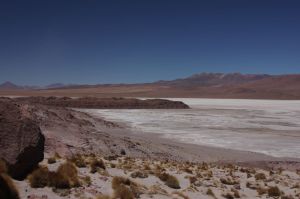
A first lagoon

A first lagoon

After you have the lagoon behind you a pretty sandy strech begins. It is pretty much the worst part and it will bring you into the national park. There is a guy living here in a small hut. You have to pay him some money and you get a ticket. Don’t loose it. It will be checked on the way out (some told us, we were not checked).

Shortly after the entrance of the national park you hit another junction. You have to take a right here. The main road is where most of the 4×4 tours come back from Laguna Verde directly. So following the main road means you miss Laguna Colorada (and you don’t want to miss that!). If you have doubts, wait until the next 4×4 arrives, stop him and ask for directions. I think the junction is approx. here (S22° 09.125′ W67° 39.732′).

This will bring you to the laguna colorada. Don’t miss the viewing point (S22° 10.222′ W67° 48.279′) and stay a night here. Watch out, the way from the camp to the lookout is best on foot (500m from the camp). The road there is really really sandy. (deep sand).

It is worth it. Going around the laguna is pretty sandy. There is a track right north of the lagoon. I have not checked it out, but it would be worth a try. It would be a lot shorter than around the lagoon. (More info see chapter INFO Laguna Colorada)
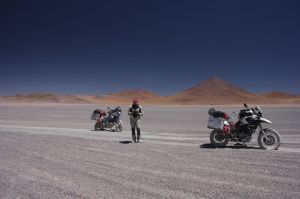
The bit around the Laguna is pretty sandy.

The bit around the Laguna is pretty sandy.

After a cold night at the Laguna Colorada the road goes up the mountain. As soon as you have left the laguna the sandy bits are over. No more sand.
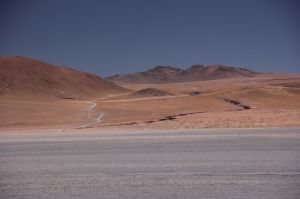
Leaving the Laguna Colorada up the mountain.

Leaving the Laguna Colorada up the mountain.

There is the Aduana (S22° 26.454′ W67° 48.357′) but you DO NOT NEED to go there You can do the customs directly at the border since 2014!

There are some geysers (S22° 26.002′ W67° 45.696′) and they are most active in the morning. So 4×4 tours start at 4am. We took it more easy and it was still impressive.

You pass another laguna (Laguna Chelviri) with hot springs. At the hot springs there is a little shop and you will find dozens of 4×4 from organized tours.

Shortly after that on your left hand side there is a fantastic rock formations on complete flat sand. For a reason this is called Disierto Salvador Dali. Its quite nice.

Finally the road leads between the Laguna Verde and the Laguna Blanca. Its a real highlight (S22° 47.292′ W67° 49.067′).
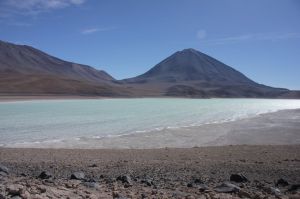
The Laguna Verde. The strong and cold wind stirred up the colourful lagoon.

The Laguna Verde. The strong and cold wind stirred up the colourful lagoon.

The road goes along the south side of the Laguna Blanca and is a bit soft (the road on the north side is a bit better id guess), but no bigger problem. Just take it easy. It is not far to tarmac anymore.

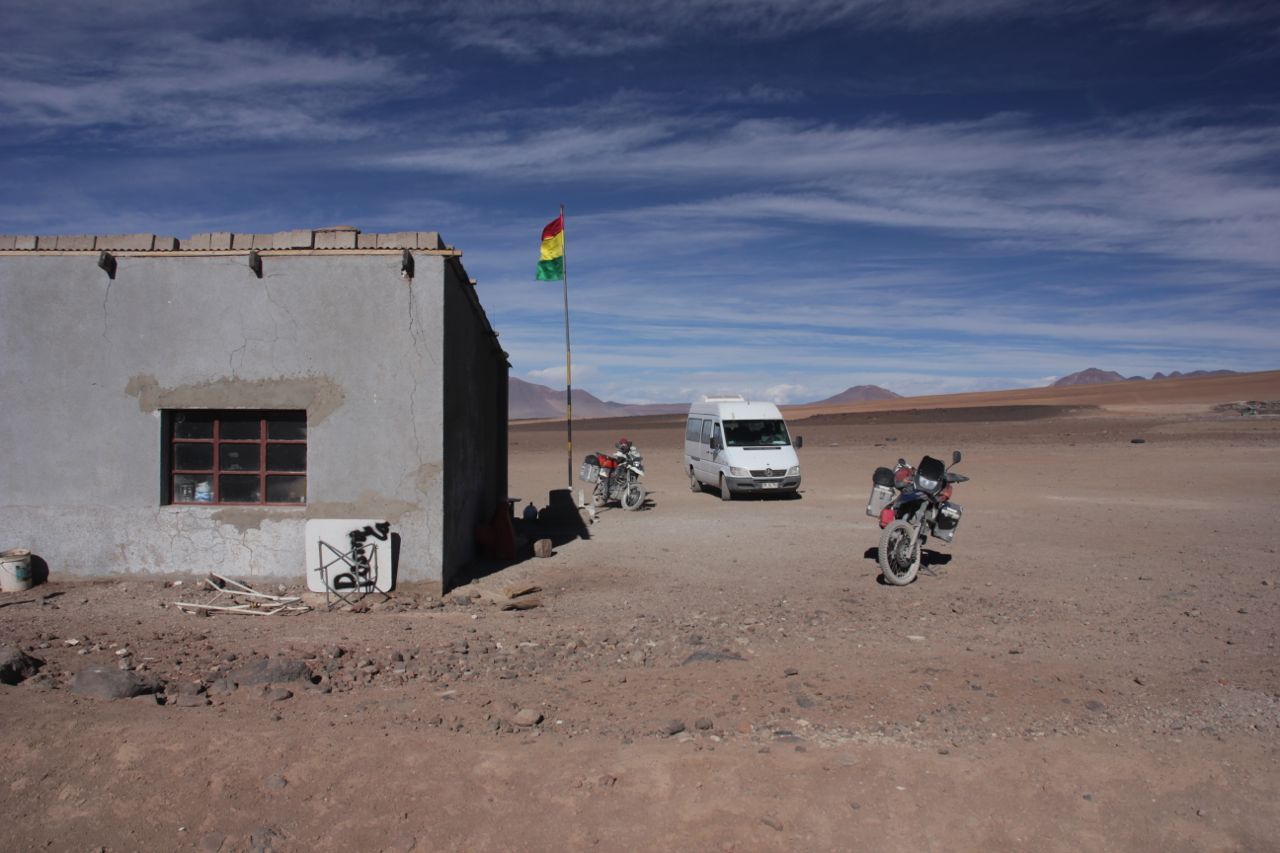
The border is not far away, just up the hill (approx. S22° 52.434′ W67° 47.426′). Not to miss. It is a small building in the middle of nowhere.

The little border crossing to Chile.

The little border crossing to Chile.

The border stuff for Chile you do in San Pedro de Atacama. Here:( S22° 54.666′ W68° 11.615′). BEWARE: you are not allowed to bring any fruits or seeds with you.

We did this route, and I didn’t have the feeling of missing something. I saw enough lagoons, and instead of the Arbol de Piedra we saw fantastic rock formations. But if you want to learn to ride sand you’d certainly should do the route 1.

GPX Tracks:

The tracks are found here:

http://www.wikiloc.com/wikiloc/view.do?id=8390836
 

Copper

Calama – Chile

I remember seeing a picture of that monster the first time.

And now it is crawling up the hill right in front of me. Slow. Roaring. Heavy.

The truck carries 400t of rock. It is an incredible sight. It slowly passes us on its way out of the mine. After it passed us all you see from behind is 4 gigantic wheels. They are more than 4m in diameter. 40.000$ worth each. And they only last 8 months.

I turn around to have another look into the mine. It is mindblowing. More than 1000m deep. 5km long. 3km wide. It is a day of unbelievable numbers. It is a place of superlatives.

We are visiting Chuquicamata, the largest copper mine in the world.

Screen Shot 2014-11-30 at 10.47.19

Almost 100 years ago they started this mine. Not knowing how big the place would become. In the meantime they started 2 other mines, digging in the same geological site. They dig for copper here, and for Molybdenum.

Only one percent of the rock is copper and they have exported more than a million tons of copper last year. Easy to understand how much earth had to been moved for that.

Now the mine is slowly getting to its end and so the output has lowered to about half this year. But they have found more copper. Another 1000m deeper. They will change this now to a subterranean mine in the future. This will also reduce the impact on the environment. The huge hole in the surface is only the most visible impact. The dust, dirt and not least the exhausts contribute to a pretty bad impact the mine has on the environment. Each truck consumes more than 3L/min. They have 100 trucks moving around the clock; they soon will be replaced by conveyer belts.

The trucks are impressive. These are the largest truck that have ever been built. Everything on them is on an almost ridiculous scale. They are more than 8m wide. The tires are just incredible. And they move, slow but constant. The huge caterpillars use only 3 shovels to fill them. So they stand less than 30 seconds to get filled. There is a lane down and one up, so it is a constant movement of huge piles of rocks.

We made a short stopover at the mine. And it is a very exciting time we spend there. These are machines like from another world. Everything is big here. The huge pick-up trucks look like small toys next to the lorries.

And it is big business here. Before Salvador Allende took over the government, this was a big North American business. Ever since the mining is governmental owned. Making 1/3rd of the annual governmental income of Chile.

Hugely depending on the copper price of course.

And so every new source is welcome. A new mine has been started just last year, offering resources of copper for another 50 years. In order to get to these sources, parts the old town of Chuquicamate has been buried under a huge pile of rocks. Even a complete clinic (one of the most modern of the country) is covered by hundreds of meters of rocks.

The rest of the town can be visited. It is a well conserved ghost town. Our guide has studied here. “Lots of good memories” he said, when talking about the stadium of the high school. He tries to smile while he says it.

Dust and colored lakes

Bolivias Southwest

Screen Shot 2014-11-30 at 10.44.13

The south of Bolivia is a wonderland for off-roading and landscapes. And of course we wouldn’t want to miss that.

I wrote a long report about this part of the trip. But I just realized I can’t express this in words.

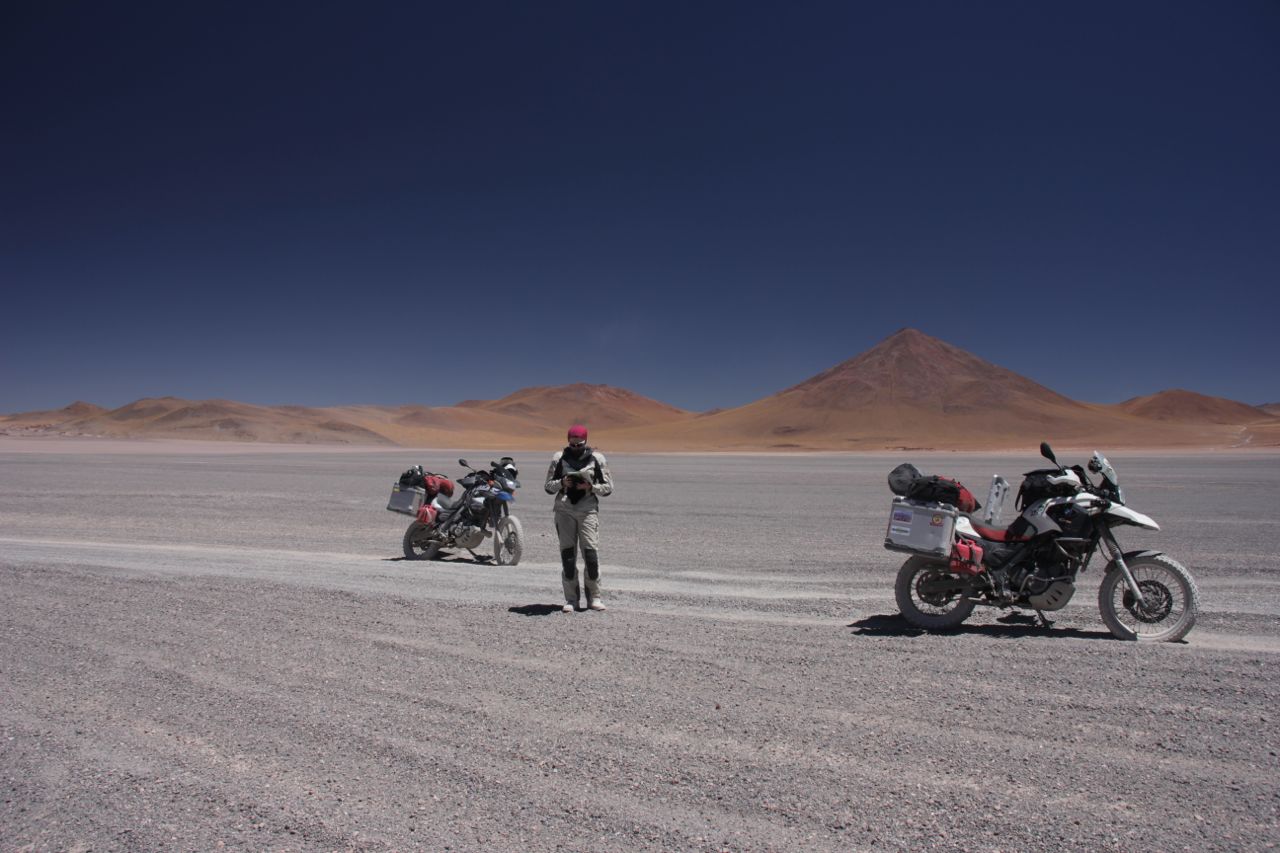
We saw the most amazing places, rode fantastic dirt roads. The landscape was dusty, colorful, vast.

We suffered from the intense sun and the dust. We hit some sandy roads and got our feet wet in river crossings. We crossed the border at over 5000m.

We saw red, white and green lakes with flamingos. We saw mountains of green, red and yellow. We had chilly nights and strong winds.

We had a fantastic time.

Take a look at the pictures and enjoy.

Salt

It is unreal! I can feel the wind. I can feel the engine working hard underneath me. I feel the vibrations of the wheels spinning at 80km/h. I know I am riding a motorbike and I have it all cranked up. I go as fast as this 400ccm Honda dirt bike runs.

And still: I don’t seem to move.

I see the hexagonal shaped salt structures fly by and I know I am moving.

But the vast, completely flat, white and endless surface of the Salar doesn’t give my brain the usual information that we usually combine with moving. Everything that I can see except the ground seems to stand still. This place really plays tricks on your mind.

I am on the Salar de Uyuni.

It is the largest salt lake in the world and it is a magic place.

Screen Shot 2014-11-24 at 18.47.55

Originally we wanted to ride our bikes to one of the islands there and camp overnight. But we were unlucky with the weather. The evening before we wanted to go heavy rain softened the surface of the Salar. That is not a problem in terms of riding. But the salty water would get everywhere on the bike, causing problems everywhere, especially on the electronics.

We decided instead to rent some small 400ccm dirt bikes.

So the day after we rode our bike to MTB where Juan, our guide, was already waiting for us.

They have a really nice workshop there and a couple of different bikes.

We chose 400ccm Hondas and took off. We made a nice little loop on sandy roads to the eastern entrance of the salt lake.

Other than one would expect, you cannot enter the salt lake everywhere. There are only few entrances to the salt lake. Close to the land the salt surface gets very soft. Only few parts are solid. It is actually quite dangerous in some areas and a lot of people had to leave their bikes out there.

As we entered the Salar, we could see that large areas were covered in water. The salty water splashed over the bike, leaving a very thick rust of salt. You had to know the way very well. Once I got maybe 5m off the track and sank into the salt surface. I got out of the situation luckily by opening the throttle all the way.

On one of the little islands we had lunch. There are dozens of 4×4 standing around pouring hundreds of tourist on the little island. But that doesn’t reduce the magic of the place in any way.

In all directions it is white and flat. In the far distance you can see volcanoes that circle the salt lake.

The volcanoes are also one of the reasons why this is an important place for bolivian industry: the salt of the lake contains 70% of the worldwide lithium resources.

The surface is not entirely flat. When the salt had dried out some 20.000 years ago, it grew in hexagonal crystals which grew until the edges met each other. Water from underneath the salt lake moves up through these border lines, leaving salt crystals on the surface as the water vaporizes in the sun. The crystals stand out as high as 10cm, showing a pattern of hexagonal little walls as far as the eye can see.

Riding on the salt lake is like on tarmac. Not slippery as one could imagine. And it is great fun.

But we are happy we didn’t bring our own bikes. The small Hondas were covered in a thick salt layer.

We return to our little hotel after dark.

It was a perfect day and we need some time to allow the brain to accept that this place is real.