Them thar hills

It’s certainly not the most romantic destination, but when we decided on Chile instead of Argentina upon leaving Bolivia, I knew just where I wanted to go — Chuquicamata! It’s not everyday that you can just stop by one of the biggest open pit mines in the world. It’s not on the list of UNESCO’s World Heritage Sites, but this active mine is a testament to human ingenuity and development.

The volcanic veins of magma which have formed these hills of the Atacama contain copper. American mining companies discovered this here over a hundred years ago. Since then, operations were transferred to the Chilean State, but the mining hasn’t slowed down a bit. Today, a third of Chile’s economy depends on copper.

Mining is a fascinating and somehow horrifying industry. This is a place of absolute superlatives. Trucks larger than in your wildest dreams, moving weights unimaginable to get at a precious metal. Well, in the case of copper not technically precious. This base mental has a current spot per pound of just under US$3. In it’s path, mining leaves behind huge waste and destruction. But we all want our stuff… Christmas lights, phone cords, electronics of all sorts, including whatever device you’re using to read this blog, contains some copper.

Environmentally, the place is a nightmare. A mere one percent of the rock they extract here is actually copper. Some additional gases and minerals are yielded in processing and we were credibly assured that nothing which can be sold goes to waste. The guide admits they haven’t really found a good solution for the dust which results after the rocks are pulverized, and water is a real issue.

Situated in one of the driest deserts in the world, the Atacama, water is a serious problem. Massive amounts are needed to process copper. On the tour, our guide told us that a new law was passed that only allows mines to use sea water for processing (background). Water trucks are everywhere along the highway (don’t even begin to think about the carbon footprint the exhaust of all this is causing…).

They are working to find better solutions, but it seems the mining brings as many challenges as it does solutions. (Interesting article.)

In Chuquicamata, they have set a target to move operations underground to exploit the new finds located below the current pit. The massive trucks will stop burning their diesel at three gallons a minute, and instead conveyors will lift the rocks to the top.

Nevermind the fascinating eyesore the mine creates. Deserts are wonderful, magical places, but this area isn’t particularly beautiful. It’s hot, dry and I imagine if weren’t for the mine, nobody would want to live here. The sandy landscapes we drove through past Calama were mostly interesting because of the mining activity.

3P – Info Part: Southwest Bolivia – Laguna Colorada

Uyuni to San Pedro de Atacama

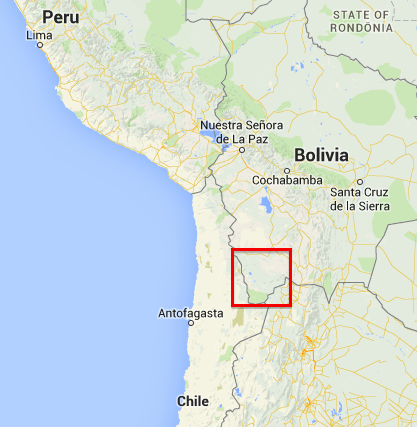
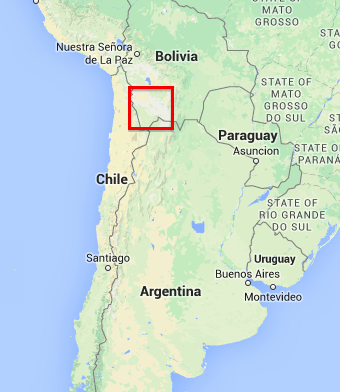
Riding north to south it seems a logical route to go from Uyuni to San Pedro de Atacama in Chile. It is fantastic ride, don’t miss it.

Here are some pictures from our trip.

Below there is some information about the ride. But first let me give you some general information:

The internet is full of reports about this area. A lot of people who did the ride had a hard time and that’s what they write. Don’t hesitate of doing it though.

With the right preparation everybody can do it on every bike (maybe not a Goldwing or a racebike).

Update: after I got an email of Bob, a great fellow, aged 74, who asked me about some details I would like to add one more sentence here: if you are not an experienced off roader, you have to be prepared to pick up your bike a few times. Little falls just may happen. At altitude of constantly over 4000m (13000ft) and at times over 5000m (16000ft) that might be strenuous. Take your time, take it easy and you are fine though.

We did it on a F650GS Dakar and a G650GS. We had Heidenau tyres which were quite low on profile.

My girlfriend made her license not a year before the trip. She had little experience before the trip and one long weekend offroading with a little Beta200. So you don’t need to be an expert at all. Just prepare and take it easy.

What you need is:

  • Fuel for 500km (we simply bought two 5L fuel cans that we strapped on the bike)
  • Enough water (we had 4L each)
  • Some money for the overnight stays (be reminded that you enter a national park where you have to pay 150Bs entrance).
  • Some snacks to keep you going during the day
  • GPS maps of the area (OSM has a good map which turned out to be very precise in this area). (The paper maps from Reise-Know-How are crap for this part of the journey).

Take your time. We made it in 3 days, which was quite relaxing.

Don’t be worried if something happens: There are many 4×4 running these roads as this is a very common touristic thing to do in organized tours (see below), so there is always help if needed. People will stop when you give them a sign. You can also ask them if you are unsure about directions. Just stop an wait a little bit. There will be someone coming.

The most4x4 tours make the loop: Uyuni-Salar-San Juan-Laguna Colorada- Laguna Verde- Villa Mar-San Cristobal-uyuni(3 days).

The 3 options:

There are basically 3 ways from Uyuni to San Pedro de Atacama.

  1. The Lagoon route via San Juan
  2. The route via San Cristobal
  3. The route via Tupiza
  1. The lagoon route is the by far most sandy one. It has a stretch of more than 60km (depending on the conditions up to 90km) sand. You pass a lot of lagoons and this is the route the 4×4 take from Uyuni via San Juan to the Laguna colorado all along the Chile-Bolivia border. You also pass the famous Arbol de Piedra, a rock formation that looks like a tree. For motorbikers this is the most strengous version.
  1. San cristobal route: This route is the one we took. It seems to be the easiest one. The first bit is in very good condition (almost like a paved road) and there are only short sandy bits of road (max. 1km). Most parts of the road are rocky and easy to ride. You pass a nice lagoon and some incredible rock formations that are certainly as spectacular as the Arbol de piedra. You can devide the road in 3 days or do it in 2 days (but that would be pretty hard or you are experianced off roader).
  1. The route via Tupiza is also pretty sandy, not as much as the Lagoon route (I was told by a 4×4 tourguide). It brings you to places where Butch Cassidy and Sundance Kid lived and died. This route I have the least information on, but for people who are experianced offroaders and who want to spend some more remote time this would be the route. There are not as many 4×4 tours on this road.

Info Laguna Colorada

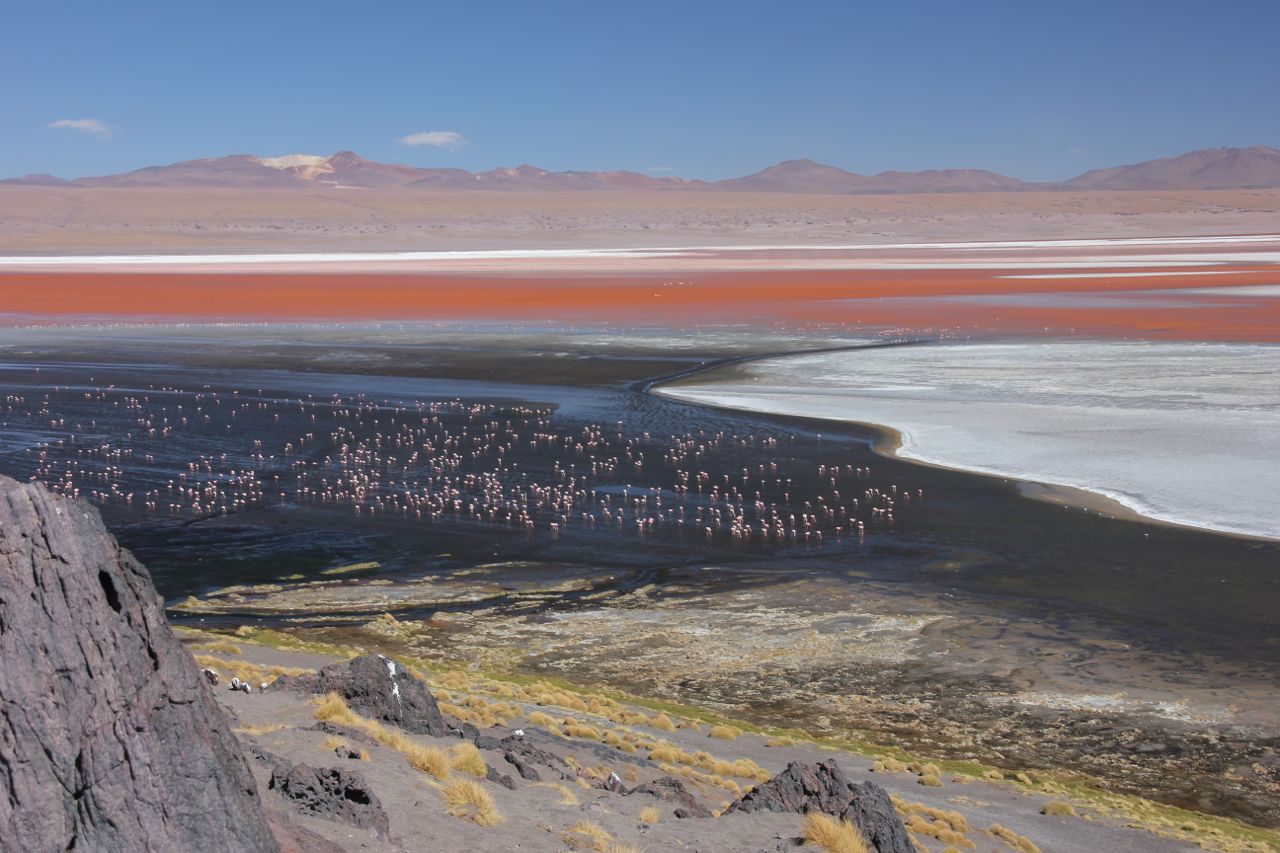
Flamingos, thousands.

Flamingos, thousands.

Route 1 and 2 are meeting at the Laguna Colarada.

There is a camp there (S22° 10.260′ W67° 49.049′) where all the 4×4 groups stay. Simple rooms usually as dorms, but you can also rent a complete dorm for yourself if you want to have some privacy.

There is another one (calls himself a hotel, but is not better than the camp(Info from a 4×4 tour guide) south of the Laguna Colorada (S22° 15.802′ W67° 48.961′). Here you can also buy water and snacks.

Close to the camp there is a lookout (S22° 10.222′ W67° 48.279′).

DO NOT MISS THAT. If you are doing route 2 go around the laguna (or take a short cut on the north side of the laguna) and go there. All the tourists go there so the place gets crowdie at times, but this place is incredible. The colors of the lagunas are in general better in the afternoon, as the strong afternoon winds stir up the water and the bacteria in it which create the great color

 Detailed describtion of Route 2:

Uyuni – San Cristobal – Villa Mar – Laguna Colorada – Camp Laguna Colorada – Geysers – Laguna Verde

The road leaves Uyuni south west direction. You pass a gas station (S20° 28.174′ W66° 49.200′) and leaving the town. The road is in very good condition. You can easily go 80km/h. In San Cristobal there is a gas station, but it does not always have fuel. So don’t count on it. But if you have very little reserve, you can try to get some fuel here.

There are also some shops where you can get water.

Shortly after the town of Villa Alota take a left (at S21° 23.974′ W67° 36.893′).

The road gets rougher now. A little bit of dust and sand is on the rocky road, so take it easy. Shortly after the turn off there is a water crossing. It is approximately 40cm deep and rocky. So you may get your feet wet. They are building a bridge there, so end of 2014 you may have a less adventurous crossing there.

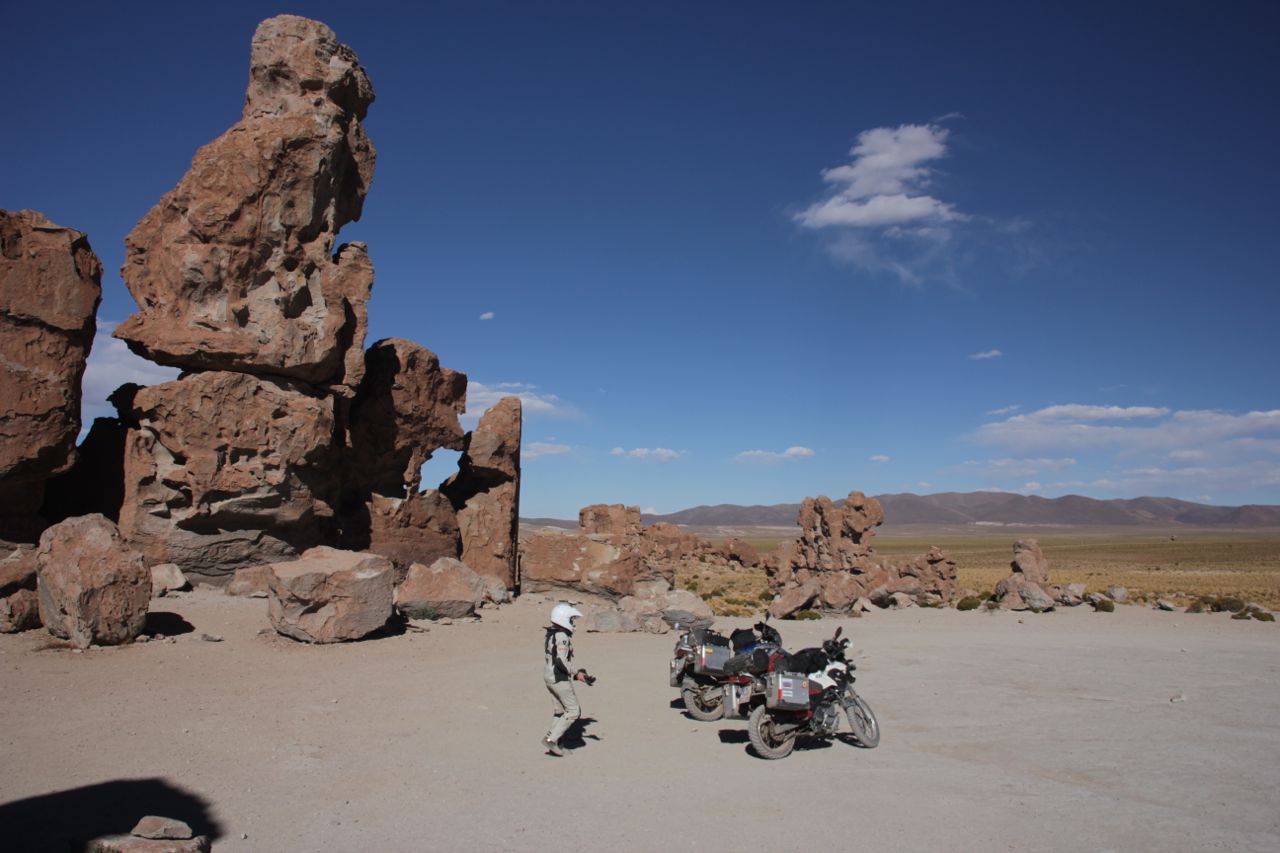
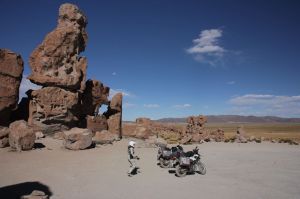
The road gets up the mountain and soon you will see amazing rock formation right next to the road on your right hand side (S21° 32.155′ W67° 34.742′). If you plan to camp, this is an excellent place.
IMG_4103 copy

The following part of the road is a bit sandy at parts, but never long stretches. And the sand is never really deep. So you can “powerwalk” through the sandy parts.

In Villa Mar there are a couple of simple B&B. The tours stop here on the way home from the Laguna Verde. We stayed here in a simple B&B at the end of the town and had a great meal in the evening and a good (simple) breakfast. You can also buy water here.

Shortly after Villa Mar you have to turn off the main road. The turn off is here (S21° 46.208′ W67° 27.818′).
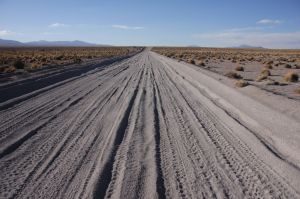
IMG_4147 copy

Turn to the right and follow up the hills into a beautiful little valley which I like to call “Lama paradise”. If you get there, you know why. The road gets pretty rocky here.

After a few kilometers you arrive at the first lagoon (Laguna Capina). You have a nice view on it. So make a break and enjoy the view.
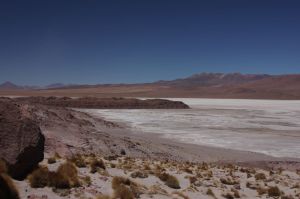
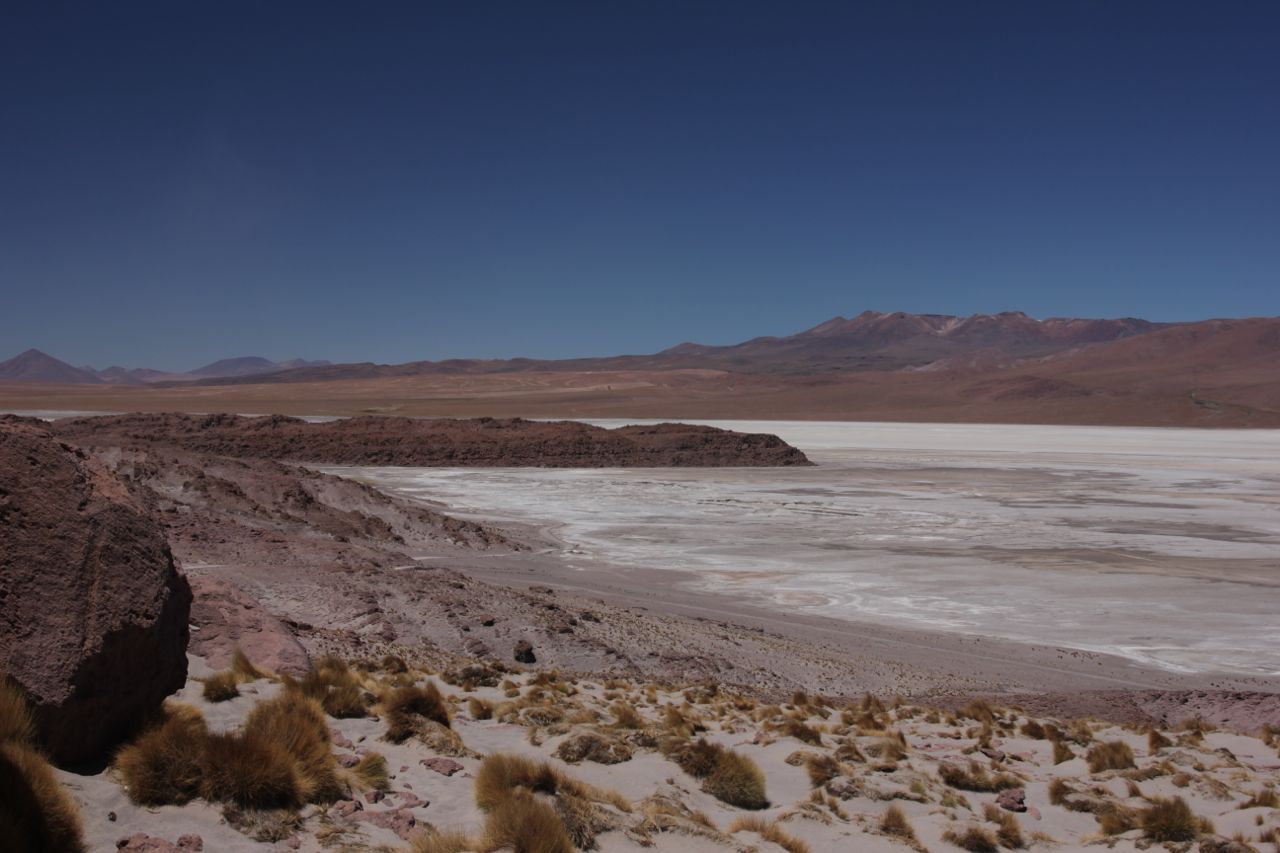
A first lagoon

A first lagoon

After you have the lagoon behind you a pretty sandy strech begins. It is pretty much the worst part and it will bring you into the national park. There is a guy living here in a small hut. You have to pay him some money and you get a ticket. Don’t loose it. It will be checked on the way out (some told us, we were not checked).

Shortly after the entrance of the national park you hit another junction. You have to take a right here. The main road is where most of the 4×4 tours come back from Laguna Verde directly. So following the main road means you miss Laguna Colorada (and you don’t want to miss that!). If you have doubts, wait until the next 4×4 arrives, stop him and ask for directions. I think the junction is approx. here (S22° 09.125′ W67° 39.732′).

This will bring you to the laguna colorada. Don’t miss the viewing point (S22° 10.222′ W67° 48.279′) and stay a night here. Watch out, the way from the camp to the lookout is best on foot (500m from the camp). The road there is really really sandy. (deep sand).

It is worth it. Going around the laguna is pretty sandy. There is a track right north of the lagoon. I have not checked it out, but it would be worth a try. It would be a lot shorter than around the lagoon. (More info see chapter INFO Laguna Colorada)
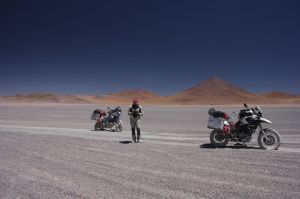
The bit around the Laguna is pretty sandy.

The bit around the Laguna is pretty sandy.

After a cold night at the Laguna Colorada the road goes up the mountain. As soon as you have left the laguna the sandy bits are over. No more sand.
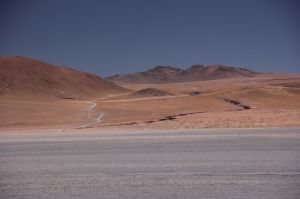
Leaving the Laguna Colorada up the mountain.

Leaving the Laguna Colorada up the mountain.

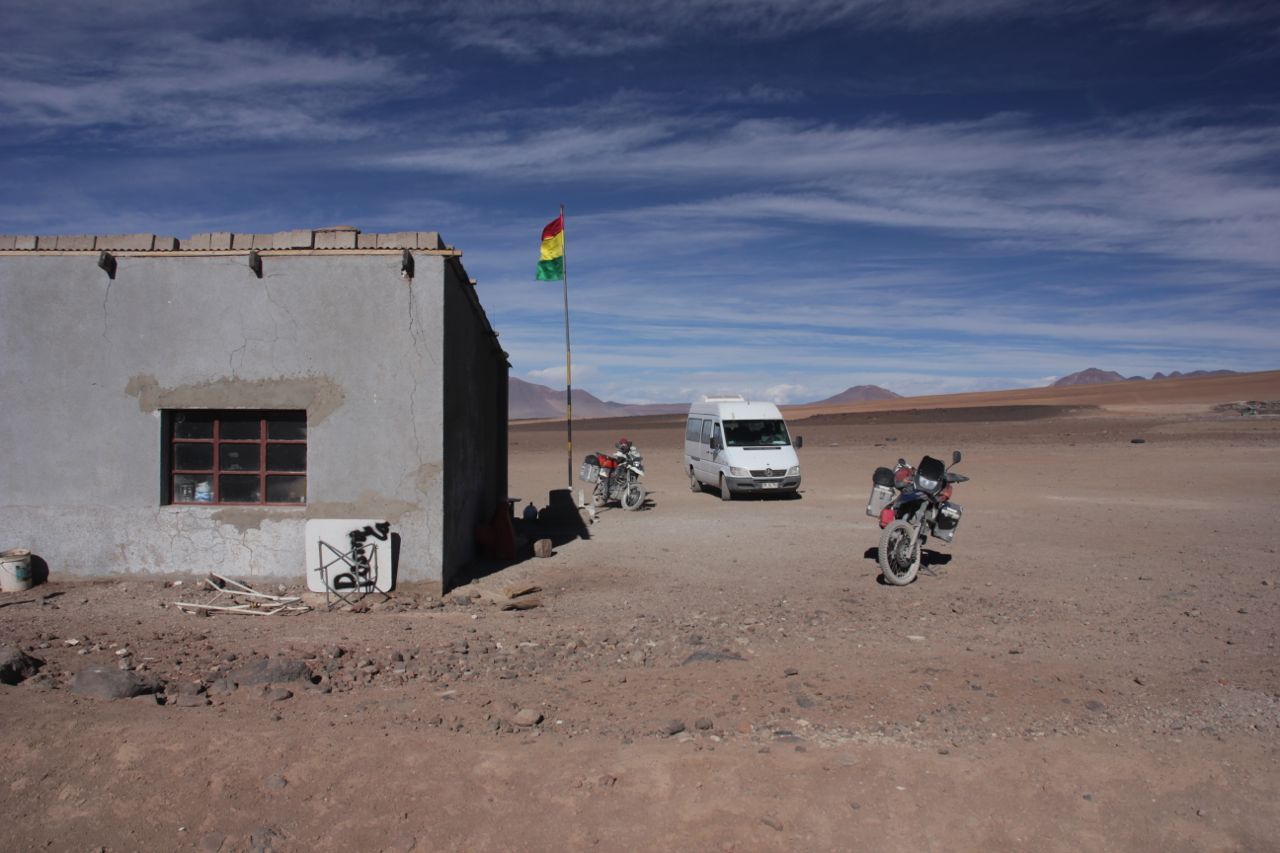
There is the Aduana (S22° 26.454′ W67° 48.357′) but you DO NOT NEED to go there You can do the customs directly at the border since 2014!

There are some geysers (S22° 26.002′ W67° 45.696′) and they are most active in the morning. So 4×4 tours start at 4am. We took it more easy and it was still impressive.

You pass another laguna (Laguna Chelviri) with hot springs. At the hot springs there is a little shop and you will find dozens of 4×4 from organized tours.

Shortly after that on your left hand side there is a fantastic rock formations on complete flat sand. For a reason this is called Disierto Salvador Dali. Its quite nice.

Finally the road leads between the Laguna Verde and the Laguna Blanca. Its a real highlight (S22° 47.292′ W67° 49.067′).
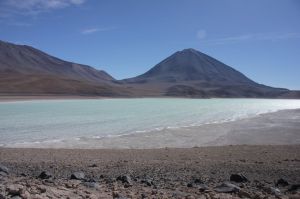
The Laguna Verde. The strong and cold wind stirred up the colourful lagoon.

The Laguna Verde. The strong and cold wind stirred up the colourful lagoon.

The road goes along the south side of the Laguna Blanca and is a bit soft (the road on the north side is a bit better id guess), but no bigger problem. Just take it easy. It is not far to tarmac anymore.

The border is not far away, just up the hill (approx. S22° 52.434′ W67° 47.426′). Not to miss. It is a small building in the middle of nowhere.

The little border crossing to Chile.

The little border crossing to Chile.

The border stuff for Chile you do in San Pedro de Atacama. Here:( S22° 54.666′ W68° 11.615′). BEWARE: you are not allowed to bring any fruits or seeds with you.

We did this route, and I didn’t have the feeling of missing something. I saw enough lagoons, and instead of the Arbol de Piedra we saw fantastic rock formations. But if you want to learn to ride sand you’d certainly should do the route 1.

GPX Tracks:

The tracks are found here:

http://www.wikiloc.com/wikiloc/view.do?id=8390836
 

Copper

Calama – Chile

I remember seeing a picture of that monster the first time.

And now it is crawling up the hill right in front of me. Slow. Roaring. Heavy.

The truck carries 400t of rock. It is an incredible sight. It slowly passes us on its way out of the mine. After it passed us all you see from behind is 4 gigantic wheels. They are more than 4m in diameter. 40.000$ worth each. And they only last 8 months.

I turn around to have another look into the mine. It is mindblowing. More than 1000m deep. 5km long. 3km wide. It is a day of unbelievable numbers. It is a place of superlatives.

We are visiting Chuquicamata, the largest copper mine in the world.

Screen Shot 2014-11-30 at 10.47.19

Almost 100 years ago they started this mine. Not knowing how big the place would become. In the meantime they started 2 other mines, digging in the same geological site. They dig for copper here, and for Molybdenum.

Only one percent of the rock is copper and they have exported more than a million tons of copper last year. Easy to understand how much earth had to been moved for that.

Now the mine is slowly getting to its end and so the output has lowered to about half this year. But they have found more copper. Another 1000m deeper. They will change this now to a subterranean mine in the future. This will also reduce the impact on the environment. The huge hole in the surface is only the most visible impact. The dust, dirt and not least the exhausts contribute to a pretty bad impact the mine has on the environment. Each truck consumes more than 3L/min. They have 100 trucks moving around the clock; they soon will be replaced by conveyer belts.

The trucks are impressive. These are the largest truck that have ever been built. Everything on them is on an almost ridiculous scale. They are more than 8m wide. The tires are just incredible. And they move, slow but constant. The huge caterpillars use only 3 shovels to fill them. So they stand less than 30 seconds to get filled. There is a lane down and one up, so it is a constant movement of huge piles of rocks.

We made a short stopover at the mine. And it is a very exciting time we spend there. These are machines like from another world. Everything is big here. The huge pick-up trucks look like small toys next to the lorries.

And it is big business here. Before Salvador Allende took over the government, this was a big North American business. Ever since the mining is governmental owned. Making 1/3rd of the annual governmental income of Chile.

Hugely depending on the copper price of course.

And so every new source is welcome. A new mine has been started just last year, offering resources of copper for another 50 years. In order to get to these sources, parts the old town of Chuquicamate has been buried under a huge pile of rocks. Even a complete clinic (one of the most modern of the country) is covered by hundreds of meters of rocks.

The rest of the town can be visited. It is a well conserved ghost town. Our guide has studied here. “Lots of good memories” he said, when talking about the stadium of the high school. He tries to smile while he says it.

Dust and colored lakes

Bolivias Southwest

Screen Shot 2014-11-30 at 10.44.13

The south of Bolivia is a wonderland for off-roading and landscapes. And of course we wouldn’t want to miss that.

I wrote a long report about this part of the trip. But I just realized I can’t express this in words.

We saw the most amazing places, rode fantastic dirt roads. The landscape was dusty, colorful, vast.

We suffered from the intense sun and the dust. We hit some sandy roads and got our feet wet in river crossings. We crossed the border at over 5000m.

We saw red, white and green lakes with flamingos. We saw mountains of green, red and yellow. We had chilly nights and strong winds.

We had a fantastic time.

Take a look at the pictures and enjoy.

Salt

It is unreal! I can feel the wind. I can feel the engine working hard underneath me. I feel the vibrations of the wheels spinning at 80km/h. I know I am riding a motorbike and I have it all cranked up. I go as fast as this 400ccm Honda dirt bike runs.

And still: I don’t seem to move.

I see the hexagonal shaped salt structures fly by and I know I am moving.

But the vast, completely flat, white and endless surface of the Salar doesn’t give my brain the usual information that we usually combine with moving. Everything that I can see except the ground seems to stand still. This place really plays tricks on your mind.

I am on the Salar de Uyuni.

It is the largest salt lake in the world and it is a magic place.

Screen Shot 2014-11-24 at 18.47.55

Originally we wanted to ride our bikes to one of the islands there and camp overnight. But we were unlucky with the weather. The evening before we wanted to go heavy rain softened the surface of the Salar. That is not a problem in terms of riding. But the salty water would get everywhere on the bike, causing problems everywhere, especially on the electronics.

We decided instead to rent some small 400ccm dirt bikes.

So the day after we rode our bike to MTB where Juan, our guide, was already waiting for us.

They have a really nice workshop there and a couple of different bikes.

We chose 400ccm Hondas and took off. We made a nice little loop on sandy roads to the eastern entrance of the salt lake.

Other than one would expect, you cannot enter the salt lake everywhere. There are only few entrances to the salt lake. Close to the land the salt surface gets very soft. Only few parts are solid. It is actually quite dangerous in some areas and a lot of people had to leave their bikes out there.

As we entered the Salar, we could see that large areas were covered in water. The salty water splashed over the bike, leaving a very thick rust of salt. You had to know the way very well. Once I got maybe 5m off the track and sank into the salt surface. I got out of the situation luckily by opening the throttle all the way.

On one of the little islands we had lunch. There are dozens of 4×4 standing around pouring hundreds of tourist on the little island. But that doesn’t reduce the magic of the place in any way.

In all directions it is white and flat. In the far distance you can see volcanoes that circle the salt lake.

The volcanoes are also one of the reasons why this is an important place for bolivian industry: the salt of the lake contains 70% of the worldwide lithium resources.

The surface is not entirely flat. When the salt had dried out some 20.000 years ago, it grew in hexagonal crystals which grew until the edges met each other. Water from underneath the salt lake moves up through these border lines, leaving salt crystals on the surface as the water vaporizes in the sun. The crystals stand out as high as 10cm, showing a pattern of hexagonal little walls as far as the eye can see.

Riding on the salt lake is like on tarmac. Not slippery as one could imagine. And it is great fun.

But we are happy we didn’t bring our own bikes. The small Hondas were covered in a thick salt layer.

We return to our little hotel after dark.

It was a perfect day and we need some time to allow the brain to accept that this place is real.

Engineer at work

or

Miscalculation I: How a long period of stress, quitting the job and the beginning of a long trip influences your ability to think.

Quito-Ecuador

To ship our bikes from Germany to Ecuador we had to empty the fuel tanks of them. We did this back in Germany by use of a hose that I fumbled into the gas tank and sucking the gas out (and since I am an German engineer I didn’t even get a mouth full of gas by using proper equipment).

So filling up the bikes after pick-up at Quito airport would be necessary. In Quito we happened on to the store of Freedom Bikes. They rent bikes and also offered us some help. To fill up our bikes with gas they loaned us a gas-can of 5 gallons (=19L). On the way to the airport we filled up the gas-can (not all the way, because the taxi driver was afraid it could leak).

Once we had the bikes out of customs we filled them up.

We were in a hurry since it was slowly getting dark (that sentence is maybe just an excuse of what follows…).

So I put about half the content of the gas-can into my bike (as an German engineer I have it in my guts to get that right!) and than the rest into Christy’s bike. I was a little bit surprised that the gas actually ran over on her bike, so her bike was totally full. But whatever, we were in a hurry…

HitchcockChristy’s bike has a 14L tank, Andy’s Dakar version has a 17L tank. Both have 4 L reserve. If you get the math right, you may find the mistake already…


We connected the batteries to our bikes (they had to be disconnected during the flight) and hoped all would be well.

Christy started her bike and all went well. I started my bike and it ran immediately. I love our bikes! But what is that? My fuel light wouldn’t turn off! Since I just put half of 5 gallons into my bike there must be something wrong with the fuel light. Well, the bike runs, lets just take care of that another day!

We made it safely back to our hotel that night.

The next day I searched to find the cause of the glowing fuel light. I checked the connectors to the fuel-sensor. Maybe something happened to the cables during the flight. But after a detailed examination all seemed to be ok. The only explanation seemed to be that the sensor itself got damaged. Maybe I damaged it while I was emptying the bike back in Germany? Maybe the hose I fumbled into the gas tank somehow damaged the fuel sensor?

Well, since Christy’s tank has less fuel capacity that wouldn’t be too much of a problem. If her fuel light turns on, I would have approx. another 100km before mine reserve would start.

So we happily started our trip going to the town of Mindo. We didn’t have to fuel up, since Christy’s fuel light hasn’t turn on yet. Mine was on the whole time, but as we know already it was faulty.

You may notice the beauty of logic of my way of thinking!

Maybe 20km before we reached the town of Mindo my engine suddenly stopped.

It was on a curvy road but on a downhill slope so I just let the bike roll to the next possible stop.

While I was rolling down that hill I made an engineering approach of finding the problem:

1.) I had maybe 18L of gas in the gas-can when filling up at the airport

2.) I was filling up half of it into my bike (=approximately 9L)

3.) I was filling up Christy’s bike till it was totally full (=14L)

4.) Together (2. and 3.) that is 23L

5.) waaait a second: didn’t we just have a 19L gas-can (not filled up all the way)

6.) sooo approx. 18L from the gas-can minus 14L of gas in Christy’s bike -> 18-14 = 4L


Conclusion 1: I only filled 4 L into my bike

Conclusion 2: I WAS running the whole time on reserve

Conclusion 3: the fuel light MAY NOT be faulty

Conclusion 4: I do NOT have it in my guts to split the content of a gas-can in two.

Conclusion 5: sometimes I AM such a fool


Well, there we were. No gas. It slowly got dark and I went on Christy’s bike to get some gas to bring us to the next town.

I asked a guy in which directions I would find the closest gas station (and I was pretty sure he said “take a right”). So I took a left and it took me forever to find the gas station (proof of conclusion 5!).

By the time I was back at Christy it had turned dark and a very thick fog had rolled in.

So poor Christy had to go down a curvy road, at night with visibility under 15m.


Well, now I knew I could really get 100km on my reserve before the engine finally stops. There is always something new to learn!


PS: My fuel light works perfectly fine.

Floating Islands

Puno – Lago Titicaca

As a kid I loved to read. And I read a lot. I loved to read the adventure books of the 50’s and 60’s. Real adventures. Real people.

I still like these kinds of books from that time. Other than today adventures were not sponsored by big companies. It was not million Dollar investments in order to create a Billion Dollar worth advertising movie for example of somebody falling into the void from a balloon at 36km altitude. Not that I don’t respect the braveness of Baumgartner doing it. But the way everything is setup is to create as much attention as possible is annoying. It is advertising at the end.

How different is the approach and the style of the older adventures, like Lindemann who crossed the Atlantic in a folding boat.

Two of the books I read intensively and loved to read again and again where the books of Thor Heyerdahl. He was a researcher and saw connections between cultures of South America and Polynesia in the Pacific. The only way he could explain that, was that people crossed the Pacific. Since everybody told him that this would have been impossible at that time he build a float (which was used at ancient times in South America), found a couple of adventures guys and crossed the ocean against all odds in order to proof his theory.

He did the same thing with a papyrus boat in order to proof that Egyptian culture may have influenced South America by crossing the Atlantic with such a boat. The boat Ra II was built at the Titicaca Lake.

The book is an incredible documentary of braveness and great spirit of adventure.

I had the descriptions of how they built the boat very vividly in my mind when we approached the Lake Titicaca on our motorbikes.

We arrived pretty late, since the ride from Arequipa was so beautiful. We decided to check into a fantastic hotel since it was out of town and we didn’t like to be in the centre of the town of Puno as it didn’t look very attractive to us.

We slept in the next morning and after a fantastic breakfast with a great view on the Lago Titicaca we took a taxi to the towns harbor and looked for a boat to the floating islands. We didn’t have to look for long, the boats found us by means of a guy who dragged tourists to the ticket office and moves them on to the boats.

The floating islands are the remaining goods of the culture of the Uru. Still 2000 people live on the islands. They live on floating islands that are created from totora reeds. There are 500 small islands, each containing 5-10 houses, each house representing a small family. Each island has an elected spokesman who is responsible for the wellbeing of the island. The Urus live from tourism. But they live the very simple and hard life on the islands. It is very traditional, no TV, no Internet. They sleep and live here.

Visitors from Puno are getting put together in boats and then shipped to the islands. There they get distributed to the different islands, so that all islands can participate from the tourism.

We were only 6 people on our boat (normally it is between 10 and 20) when we arrived on “our” island.

Jose, the spokesman welcomed us and lead us around the island. There is a circle of benches, 6 little huts, a little tower. All made of totora reeds. Including the island itself of course. It is a weird feeling to walk on the soft ground. You are walking on a thick layer of these reeds. In areas which are more walked, the reeds are broken and are short. On the edge of the islands, the reeds are long. You can notice that they are spread out in one direction. Jose tells us that this is how they maintain the islands. Once a week they put on a new layer of reeds. After a while they break and you have to put on a new layer. They old layers are getting soaked by water and start to rot. And indeed, if you are moving away the top layer of the reeds you feel the moist already and only 10cm deep the ground is completely wet.

After we have seen everything each of the families put up their little stand to sell little items. This is the only income for these families. So we bought some little handcrafts from each of the families.

Later we boarded the “Mercedes-Benz” how Jose called his little reed boat to ride it across the lake to the main island where we got picked up by our motorboat to get back to Puno.

His two little daughters accompanied us and told us a little bit about their life as well. They go to a school here on the floating islands. They very rarely go to Puno and have never been anywhere else.

Even though the complete tour was fully organized and a well structured tourism event, I really enjoyed it.

These islands and the way of life of these people there is so unique, that I was able to ignore the whole system that they have set up here. Tourists get processed like in a manufacturing belt. But the life the Uuos choose to live is very hard. And to reserve the culture of their people by living this hard life gets all my respect.

To be able to ride on one of these reed boats and to get a little bit the feeling of how Heyerdahl and his daredevil friends travelled the Atlantic was priceless.

I had a great day. And the fact that this was my birthday just made it a perfect present for me.


A dusty road and up the mountains

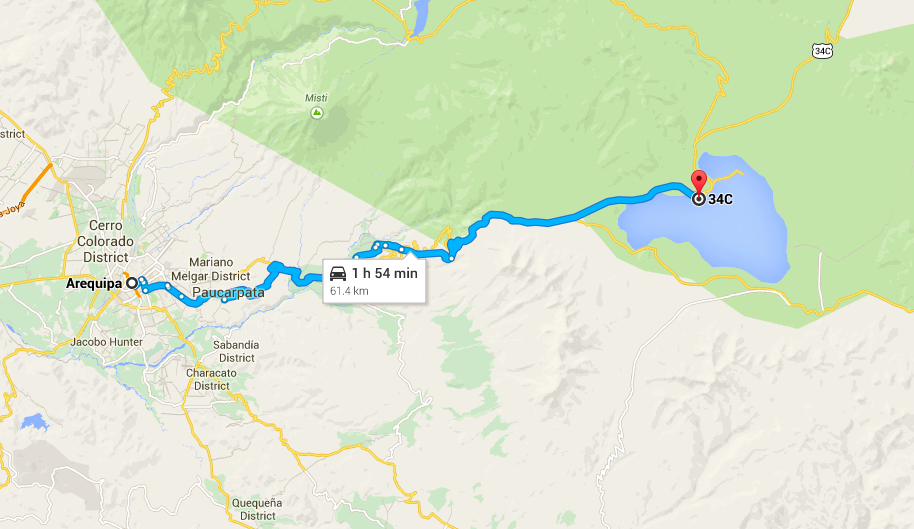
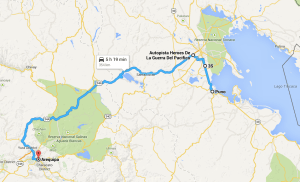
A little road leads all the way from Arequipa through the Salinas national park to Ouno at the Titicaca lake. It would be a pretty long way though and so we thought of instead take a daytrip with no luggage to a laguna in the Salinas NP. It turned out to be a great idea. First because the lake was really nice, and more importantly, we didn’t have any luggage with us: the road was a killer for being on the bikes.

Screen Shot 2014-11-14 at 23.33.47

In endless curves it ran up a mountain. The road was one of the dustiest roads I have ever been on. In the curves the dust was 20cm deep with loose rocks underneath. So if you didn’t have enough speed your front wheel would slide and bounce from one side to the other. The only safe way beside speed was foot peddling through (Christies “powerwalk”).

We were covered in dust. But it was also a road of fantastic views.

Screen Shot 2014-11-14 at 20.58.52

The next day we packed our bikes and took the main road to Puno. It was a great ride: good tarmac, a lot of Vacunas, Lamas and Alpacas, a wonderful landscape.


We enjoyed it a lot. It was very relaxing.


High mountains and deep canyons


The Canon de Colca is one of Perus natural highlights as they say. It is very often compared to the Grand Canyon. But other than his famous colleague in the US this canyon is not located in a flat area. It is surrounded by the Andean mountains towering with 5200m over it’s river bed. This creates an incredible sight.

The tourists get there by bus from Arequipa as a one or 2-day organized tour.

Screen Shot 2014-11-07 at 20.59.55

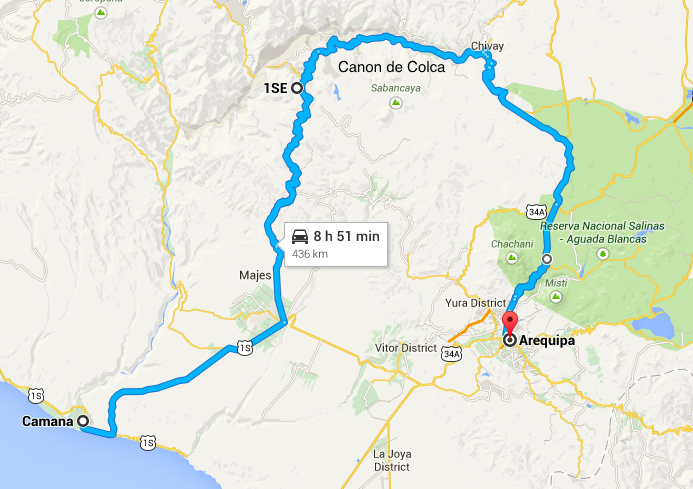
For us on the bikes there are other options of course and so we take a long dirt road via Huambo. We start in Camana driectly on the coast very early in the morning. After 80km on tarmac we turn off to a dusty gravel road. It has quite a lot of corrugations and so our bikes get shaken pretty well.

The road climbs up the mountains and slowly the desert gets a more and more spots of vegetation. Small bundles of grass start to grow and once in a while even a little bush finds enough humidity to live here.

Little flowers contribute yellow spots to the brown of the grass and dust.

After we have about half of the dirt road (80km) the road gets steeper and we start noticing snow covered mountains around us. It turns out to be the surrounding volcanoes, some of them reaching more than 6000m. The landscape is fantastic. A mountain pass at 4200m offers a breathtaking view into a broad valley, which ends in the far distance with a sharp edge, the first sight of the Calco canyon. We make a break, but after being on the coast at sea-level for more than a week, we are pretty out of breath. We continue on the road which is getting more rough but with less corrugations which makes riding actually more enjoyable. There are hardly any cars here. During the 6 hours we spend on the bikes we only saw a handful of cars or trucks.


As we descend from the mountain pass we enter the little village of Huambo. Lots of people in traditional clothing are gathered on the Plaza del Armas, the main plaza. Traditional music is being played from loudspeakers and a lady is commenting the appearance of little dance groups. Trucks and even a bulldozer are setup as floats parading in front of the inhabitants of the village. It is the 124th anniversary of the village and they are celebrating it very nicely. We stand somewhere on the side and get in contact with people immediately. So we stand there, drink some coke and eat some cookies, which we bought from the store next to our bikes and watch the parade going on.

It is really nice and enjoyable.

After a while, just before the parade is finished we jump on our bikes and continue the last 30km to Cabanonde.


The place we stayed is famous for its kitchen (Kuntur Wassi) and so we had a delicious dinner of Alpaca meat. We got up early in the morning to reach a steep cliff. When the early sun hits the canyon condors use the thermal lift to rise up and go hunting. As we approach the Cruz del Condor there are already a couple of tour busses waiting. We jump off the bikes and just make it in time to see some of the huge birds flying-by real close. It is an impressive sight to see this majestic birds sailing in the warm wind.

After 15 minutes the birds are gone. Time to see what else there is to see. The canyon is incredible: deep down you can see the Colca river a 1200m below. Above it the 5200m high Senal Ajiruha mountain towers over the canyon. There are some frozen waterfalls up there. It is almost unreal as the rest of the area is quite dry. We enjoy the view for some more time and keep going following the route of the busses back to Arequipa.

The Canyon gets wider and lots of terraces are build into the walls. It turns very green with all these fields. It is one of the main agricultural areas of Peru. We reach the next town that is at 3600m and fill up our bikes. Then we start the ascent on asphalt now, up to the 4800m mountain pass of Patapamba. The ride is incredible, with great views into the valley of the Colca canyon. The top is quite flat and offers a fantastic sight to the volcanoes surrounding the area.

As we don’t want to take the long main road to Arequipa we decide to take a little short cut. A dirt track leads in between two massive volcanoes (Misti 5800m and Chachani 6000m). The road is pretty good and almost flat so we proceed very well. As we hit the flank of Chachani it gets pretty sandy at some parts though. It is not real sand, it is ashes from the volcanoes and it is very very soft. Christy had some difficulties and I fell twice as well. Since we were at 4000m altitude picking up the bikes was quite a strenuous work.

But most of the time the road was very rocky and so we made it back ok to tarmac and then into the nice city of Arequipa.

We decided to stay a full day there to “recover” from all the incredible sights and rides we have had the last week.

Sand and Sea

Nazca to Camana

Screen Shot 2014-11-06 at 15.29.55

Screen Shot 2014-11-06 at 15.29.24

We left Nazca to make a little detour to have a nice view on the Cerro Blanco, the highest sand dune in the world. We are not very tempted by superlatives, but this dune is an astonishing 2800m high, just 50km from the sea. We love sand and dunes and so we were very curios to see it.

We ride into a dry valley which starts right in Nazca. On both sides mountains with soft shapes accompany the valley. Almost no vegetation is found here; just on the bottom of the valley there must be a little bit of water as some plants create a pattern of green once in a while.

Suddenly the peak of the Cerro Blanco appears over the smaller mountains in the foreground. The name is describing it pretty well. With all the brown mountains surrounding us the bright color of the Cerro Blanco sticks out and appears almost white. We find an opening in the mountains and turn off the paved road to get a closer look. Soft sand makes riding a lot of fun and as we approach we finally see the full flank of the mountain. A wall of more than 2300m of sand is piling up in front of us. It is an incredible sight.

We ride further down the bumpy track until it gets too difficult for Christy on her heavy bike.

We go back to the main road and continue until we reach a mountain pass. From here you can approach the summit of the Cerro Blanco. We stop, enjoy the view and play a little bit in the soft sand, but there is no point on continuing uphill with the loaded bikes.

So we turn around to Nazca and keep going south the PanAm.

After a few kilometers we get off it again to follow a sandy dirt road to a cemetery from pre-inca times: Chauchilla. Tomb raiders have dug the ground to find treasures and so the dead had been laying there in the open field for centuries. A few years ago officials have restored some of the graves and put the bodys into their original graves.

Since in the past years people have wandered around the dead and sometimes even posing with them for photos I think restoring the graves has been a great thing to do. It gives some dignity back to this place.

The whole place still is covered in bones, hair, clothing, clay fragments and other parts of the graves. All over are little dips, indicating other graves that have been opened.

We are the only visitors. It is boiling hot in the sun. The place is surrounded by hills in different colors. The place offers a strange morbid beauty and peace.

The deads have been dried in their graves to mummies. The many years in the sun have whitened their bones. So here they sit in their new graves with some rests of their belongings. It is really macabre and strange. But also beautiful and peaceful.

We hit the PanAm at around 1 and we have decided to go till the town of Chala. We expected the road to be sort of boring and to be one of the parts where we would just cover distance.

But we were wrong! It was a fantastic ride with lots of stops to enjoy the constantly changing scenery.

The landscape can be described in one sentence: Desert to the left, black strip of PanAm in the middle, blue sea to the right.

But the diversity was mind-blowing: we passed sections with complete flatness, areas with beautifully shaped rocks, colors of red, green and yellow. At one point the dunes towered a few hundred meters and rose directly from the sea. About have way up the PanAm crosses the dunes flank. We passed deserted sand beaches for kilometers. Sometimes the coast was rocky with the waves wildly shattering on the cliffs. Sometimes the sea was rolling in long surfers paradise waves upon shallow beaches.

The sea was deep blue, forming a perfect contrast with its freshness and vivid nature in comparison to the complete lack of water and lifeless desert on our left.

It was 400km of pure pleasures. From Nazca to Camana with an overnight stop in Chalca.